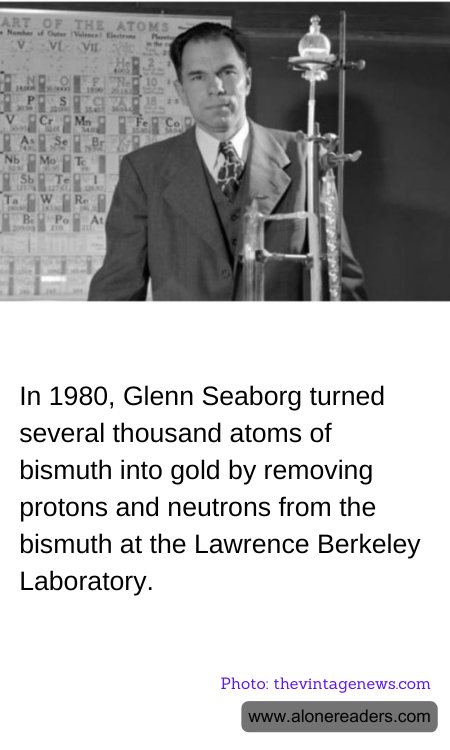
The quest to turn base metals into gold has fascinated alchemists for centuries, but it wasn't until 1980 that this ancient ambition approached a semblance of scientific reality. Glenn Seaborg, an American chemist and Nobel laureate, achieved a modern form of alchemy at the Lawrence Berkeley Laboratory, though not exactly as the medieval alchemists had envisioned. Seaborg, who had previously co-discovered plutonium and multiple other actinide elements, utilized his formidable knowledge in nuclear chemistry to transform bismuth, a basic metal, into gold.
This transformation did not involve mystical spells or secretive incantations but was achieved through a process that adjusted the very building blocks of nature—protons and neutrons. Bismuth, which has an atomic number of 83, was bombarded with alpha particles which facilitated the shedding of protons and neutrons. The outcome was an atomic number adjustment leading to an element with atomic number 79—gold. The process was done on a minuscule scale, producing only a few thousand atoms of gold, which were not visible to the naked eye and far from being of any economic value.
Despite its lack of commercial application, the experiment was a groundbreaking scientific endeavor. It showcased not just the possibility of converting one element to another but demonstrated the incredible advancements in the field of nuclear chemistry and particle physics. Seaborg's experiment essentially underscored the fundamental principle that elements are defined by the number of protons in their nuclei and that altering the number of protons changes one element to another.
However, the cost and energy required to induce such transformations are staggering. The modern alchemy exhibited in Seaborg's experiment is neither practical nor economical for producing gold or any element; the energy input far exceeds the output. Thus, while Seaborg's success at transmuting bismuth into gold stands as a remarkable scientific achievement, it remains a proof of concept rather than a practical technique for element production.
In contemporary times, the implications of Seaborg's work extend beyond the mere conversion of metals. The methodologies and technologies developed from these kinds of experiments contribute broadly to various fields, including nuclear medicine, where isotopes are routinely transformed for diagnostic and therapeutic purposes. Seaborg's exploration into the heart of the atom deepens our understanding of the elemental forces that construct everything in the visible universe. It remains a testament to human curiosity and our unending quest to understand and manipulate the fundamental components of matter.
