More About This Card
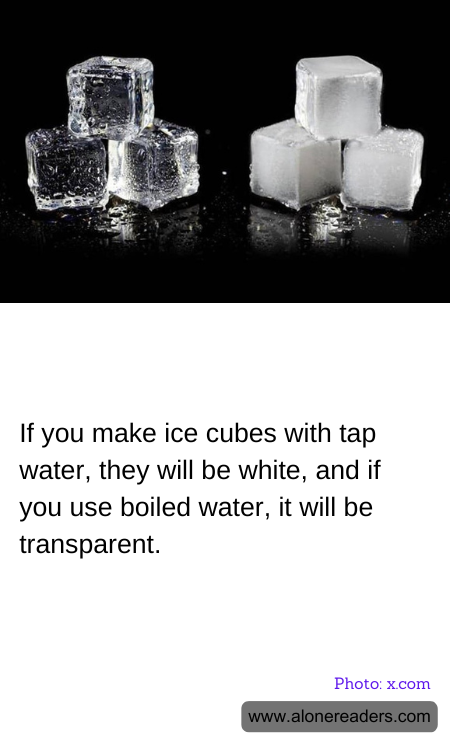
Ice cubes made from tap water often have a cloudy or white appearance, while those made with boiled water tend to be much clearer. This difference in clarity is primarily due to the way water freezes and what is contained in it. Tap water typically contains impurities and dissolved gases, such as oxygen and nitrogen. When water freezes, it does so from the outside in, pushing most of the impurities and gases towards the center, which results in the cloudy or white center commonly seen in ice cubes.
Boiling water before freezing it can significantly reduce these impurities and gases. Boiling forces the dissolved gases out of the water, as evidenced by the bubbles that emerge during the boiling process. Without these impurities and gases, there is less material within the water to disrupt the freezing process, allowing the ice to form more uniformly and transparently.
Moreover, the rate at which water is frozen also affects the clarity of the resulting ice cubes. Slow freezing, which occurs in most household freezers, allows time for ice crystals to form around impurities, leading to cloudy ice. Professional ice makers and high-end bars often use specialized equipment to produce clear ice through a process called directional freezing. This method freezes water from the top down or from one direction, which pushes impurities away from the forming ice, resulting in a much clearer cube.
In addition to aesthetic appeal, clear ice tends to melt slower than white ice due to its density and purity, making it preferable in cocktails and other beverages where dilution from melting ice might negatively affect the flavor. Therefore, using boiled water not only improves the visual appeal of ice cubes but can also enhance the drinking experience by providing a slower-melting cube.
In conclusion, the key to making transparent ice cubes lies in reducing the impurity content and dissolved gases in the water, which can be effectively achieved by boiling water before freezing. Additionally, the freezing method and speed play crucial roles in the clarity of ice. While the process of making clear ice requires extra steps, the result is aesthetically pleasing and potentially enhances beverage quality.