More About This Card
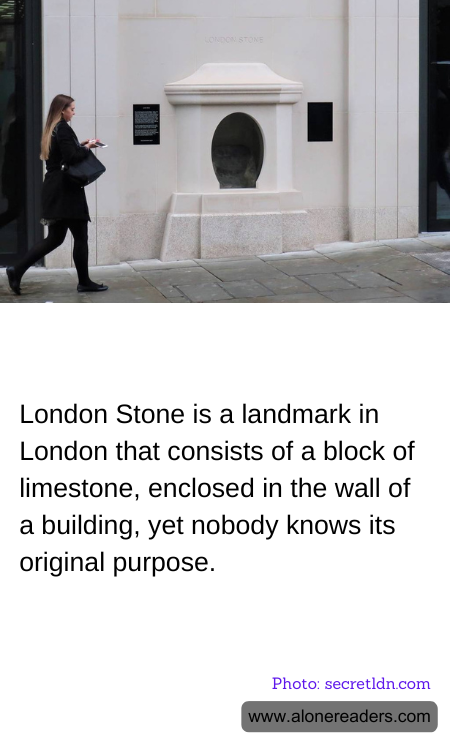
London Stone is steeped in mythology and mystery, a seemingly nondescript block of limestone that has captured imaginations and provoked scholarly debates for centuries. Its origins and purpose, shrouded in the mists of time, remain as much a puzzle today as they have ever been. Traditionally housed at 111 Cannon Street in the City of London, this relic is embedded within a protective grille, which allows passersby to glimpse a piece of London's elusive history.
The stone’s recorded history stretches back to the medieval period, though its true age and the continuum of its significance are speculated to reach further back into the Roman occupation of Britain. Over the centuries, it has been variously described as a Roman milestone from which distances were measured, a druidic altar for performances of ancient rites, or even a symbolic artefact of leadership—the heart of London, from which authority and governance radiated across the city.
Historically, the London Stone was much larger than the remnant preserved today. Previous accounts describe it as a significant landmark, positioned at street level where it might readily engage the public's attention. Its reduction in size and relegation to a sideshow curiosity speak volumes about the city’s ever-changing landscape and priorities. In the 18th century, it was deemed important enough to be continually remounted and preserved through successive reconstructions of its host building. Its survival through the Great Fire of London and the devastating bombardment of the Blitz during World War II adds to its legend, embedding it even deeper into the fabric of city lore.
Literary references to the London Stone add layers to its mystique. Notably, Shakespeare mentions it in “Henry VI, Part 2,” where Jack Cade, a rebel leader, strikes the stone with his sword and declares himself “lord of this city." Such mentions suggest that in its heyday, the stone held significant symbolic authority—a testament or witness to civic pride and legal bindings.
Today, while the original purpose of the London Stone remains an enigma wrapped in conjecture, its cultural and historical significance is undeniable. It stands as a testament to the rich, complex tapestry of London’s history, embodying the mystery and enduring spirit of the city. Whether as a relic of power, a marker of lost rituals, or simply a touchstone for the city’s identity, London Stone continues to be a focal point for both academic interest and public curiosity. In this way, it serves not only as a remnant of the past but as an ongoing invitation to ponder the layers and dimensions of history that compose urban identity and heritage.