More About This Card
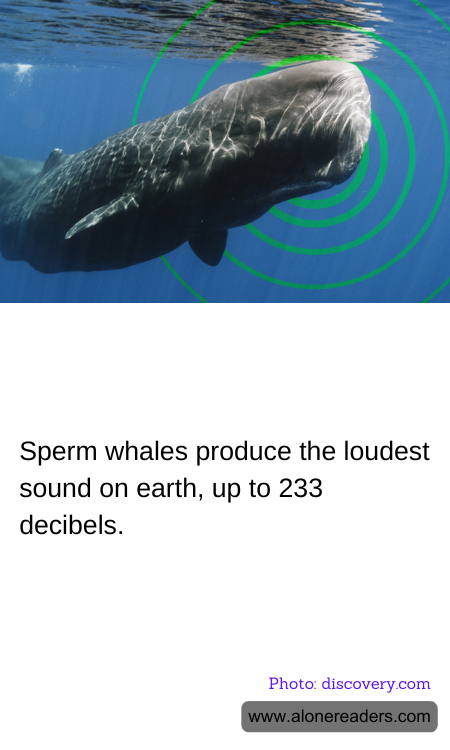
In the vast expanses of the world's oceans, the sperm whale distinguishes itself not only as one of the largest of Earth’s creatures but also as the loudest. Capable of producing a sound reaching up to 233 decibels, these impressive marine mammals surpass even the noise levels of jet engines, which typically measure around 150 decibels. This extraordinary ability helps sperm whales navigate and communicate in the deep, murky waters they inhabit.
The sounds produced by sperm whales are not just loud but are crucial for their survival. Known as echolocation clicks, these intense noises serve as biological sonars. Sperm whales emit a series of clicks that travel through the water until they hit an object, such as the seafloor or a school of fish. The sound then echoes back to the whale, which interprets these sound waves to discern the size, shape, distance, and texture of objects in its path. This allows them to hunt prey even in complete darkness, thousands of feet below the ocean’s surface.
These clicks are generated by air being passed through nasal passages and then amplified by the whale’s large, oil-filled head, known as the spermaceti organ. Fascinatingly, the shape and size of this organ may help focus the sound waves into a tight beam, which can be directed with pinpoint accuracy. Researchers believe that the spermaceti organ’s structure might also be adjustable, allowing whales to change the focus of their sound beam as needed.
Sperm whales use lower amplitude clicks for long-range communication with other whales and may have diverse "dialects" determined by specific patterns of clicks. These patterns help them keep together as a pod and coordinate their activities, which is vital for their deep-sea hunts and social interactions.
Understanding and studying the sound production of sperm whales not only captivates those with a keen interest in marine biology but also aids in the conservation efforts of these magnificent animals. Their clicks can be monitored to track populations, migration patterns, and even to identify and protect their habitats. As human-induced noise pollution in the oceans increases, understanding how these sounds affect sperm whales is crucial as it may interfere with their communication, hunting, and navigation.
Indeed, the sperm whale’s ability to produce the loudest sound of any animal on earth is not just an interesting fact but a remarkable adaptation that underlines the complexity and interconnectivity of ocean ecosystems.