More About This Card
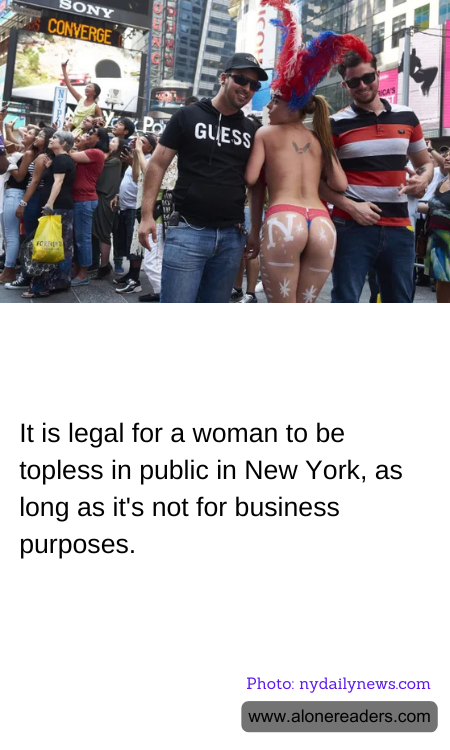
In New York, the laws regarding public decency and expression have evolved significantly over the years, leading to some progressive legal stances on issues of nudity. Specifically, the legality of women being topless in public spaces has been clearly defined: women can legally be topless in any location where men can be without violating any indecency laws. This right was solidified in the early 1990s following a series of court cases, most notably the New York State Court of Appeals ruling in 1992, which established that women have the same right as men to remove their shirts in public.
This legal stance stems from the emphasis on gender equality and the interpretation of what constitutes indecency. The ruling was aimed at abolishing gender discrimination and ensuring that women have the same rights as men concerning being shirtless. The decision highlighted that being topless does not inherently constitute sexual conduct, and thus, should not be treated differently based on gender.
However, the law does draw a line when it comes to commercial activity. While it is legal for a woman to be topless in public for non-commercial purposes, such as sunbathing or participating in a parade, using toplessness for business means—such as in advertisements or adult entertainment—brings different legal considerations and regulations into play, often governed by local obscenity laws and zoning codes that regulate commercial activities.
Though legal, the societal acceptance of public toplessness varies widely across different communities in New York and beyond. In urban areas like New York City, instances of toplessness in places like beaches, parks, or during public events like the Pride Parade, are not uncommon and are generally met with a more liberal response. However, in more conservative locales, such reactions might be less accepting.
This policy also interacts intriguingly with public events and artistic expressions. For instance, the annual GoTopless Day parades, which advocate for gender equality in toplessness laws, are held without legal repercussions for the participants who choose to be topless. Similarly, artists who use the human body as a medium for their artistic expression can do so without the fear of legal consequences, provided the nudity is not sexually suggestive but rather artistic in nature.
The law in New York regarding women being topless in public underscores a broader movement toward gender equality and the normalization of the human body. It highlights an approach that distinguishes between nudity as a natural state and nudity as a sexual objectification, aiming to reduce the legal disparities between genders in terms of personal freedom and expression. While the implementation of this law can differ greatly based on public sentiment and cultural context, its existence marks a significant step toward equality and sheds light on the evolving definitions and boundaries of decency and rights.