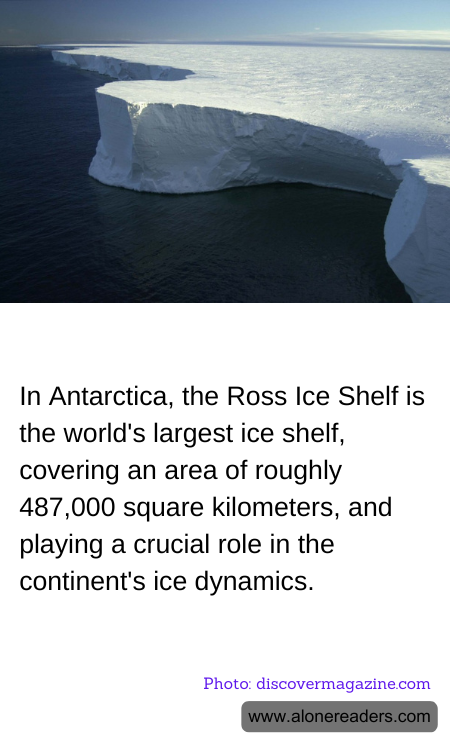
Antarctica's Ross Ice Shelf, a massive platform of floating ice, dominates as the largest ice shelf on the planet. Spanning about 487,000 square kilometers, this colossal ice structure is approximately the size of France. It forms a critical component of the Antarctic ice system, acting both as a barrier and a balancer in the environmental equation that governs the region's temperatures and sea levels.
The significance of the Ross Ice Shelf extends beyond its sheer size. As it floats on the ocean surface, the shelf plays a pivotal role in stabilizing the glaciers behind it. By blocking the flow of these glaciers into the sea, the shelf prevents potentially massive increases in sea levels. Essentially, it acts like a giant plug that holds back the ice from the land and slows its journey into the ocean.
Understanding the dynamics of the Ross Ice Shelf is crucial in the context of global climate change. The shelf is subject to both atmospheric and oceanic influences, making it sensitive to shifts in temperature and currents. Recent studies have shown increasing surface melting and basal melting—where the base of the shelf comes into contact with warmer ocean water—that could hasten its decay. This melting at the base not only affects the shelf structure but also poses a risk of accelerating sea-level rise if substantial portions of the ice were to break off or if more glacial ice were allowed to flow into the sea.
The Ross Ice Shelf also offers unique opportunities for scientific research. Scientists drill through the ice to obtain ice cores, which contain trapped air bubbles that serve as miniature time capsules, preserving records of ancient atmospheres. These cores provide crucial data on past climate conditions, offering insight into how climate has changed over time and improving our understanding of contemporary climate trends.
As climate models continue to develop, keeping a close watch on the Ross Ice Shelf remains a priority for researchers and climatologists. The stability of this ice shelf influences global sea level and broader climate patterns, thus its health is an indicator of the larger dynamics at play in Earth's polar regions. Monitoring and understanding the changes happening in and around the Ross Ice Shelf will be key to predicting and mitigating the impacts of global warming on our planet’s low-lying areas and coastal cities.
