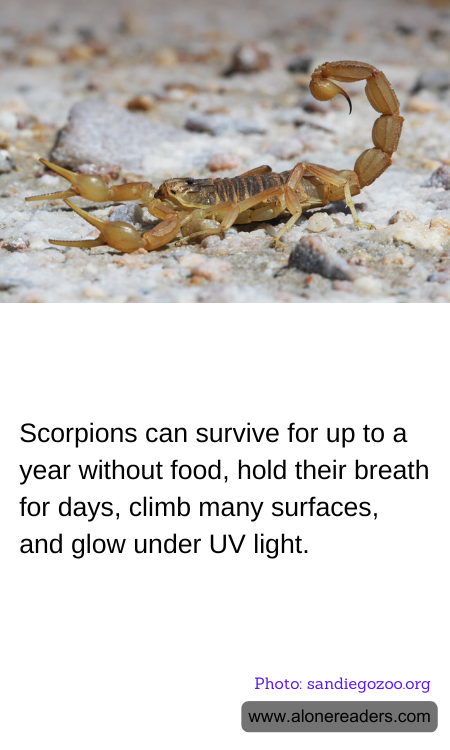
Scorpions, those often misunderstood arachnids, are some of the most resilient creatures on Earth. Known for their menacing appearance and painful sting, scorpions have a range of remarkable adaptations that allow them to thrive in some of the planet's most challenging environments. One of their most astonishing abilities is their capacity to survive for up to a year without food. This extraordinary feat is possible due to their slow metabolism and efficient use of body resources. When food is scarce, scorpions enter a state of slowed metabolism, reducing their energy requirements to a bare minimum.
Additionally, scorpions possess the remarkable ability to hold their breath for extended periods. They can suppress their need for oxygen and survive in low-oxygen environments by slowing their metabolic rate. This adaptation is particularly useful when hiding from predators or waiting for prey in confined spaces where air supply might be limited. It's fascinating that these creatures can survive underwater or in sealed spaces for up to six days by curbing their respiratory rate.
Climbing is another area where scorpions excel due to their specialized clawed appendages called "pedipalps." These allow them to grip and scale a wide variety of surfaces, from rough tree bark to smooth rocks. This ability not only aids them in escaping predators but also in ambushing prey. Their agile climbing skills reflect their adaptability and survival strategies in various ecosystems, from arid deserts to tropical forests.
Perhaps one of the most visually intriguing aspects of scorpions is their ability to glow under ultraviolet light. This fluorescence is due to a substance found in the hyaline layer—a very thin layer in a part of their exoskeleton called the cuticle. When exposed to UV light, the hyaline layer absorbs the light and re-emits it as a bright blue-green glow. While the exact purpose of this fluorescence is not fully understood, some theories suggest it helps scorpions find each other or could act as a kind of sunscreen to protect them from sunlight.
These fascinating abilities—extreme survival tactics, effective climbing skills, and mesmerizing fluorescence—highlight the scorpion's evolutionary success. Their capability to adapt to harsh environments not only makes them intriguing subjects of study but also epitomizes the remarkable adaptability of life on Earth.
