More About This Card
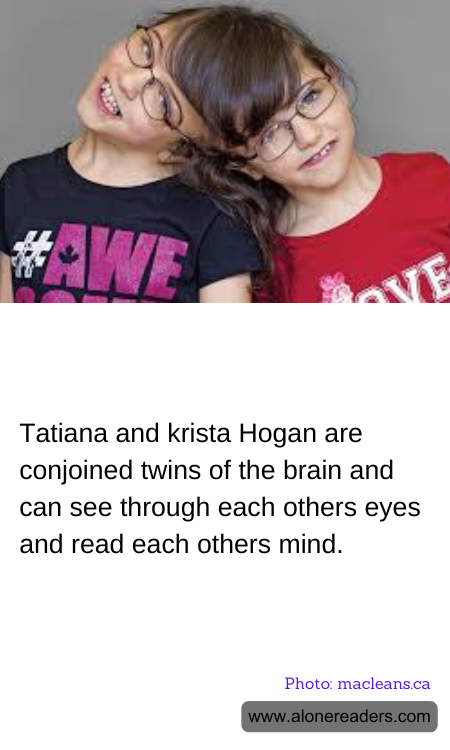
Tatiana and Krista Hogan are a remarkable pair of conjoined twins from Canada, who share a unique and extraordinary connection that has fascinated both the medical community and the general public. Born in 2006, the twins are craniopagus, meaning they are joined at the head, an incredibly rare condition that occurs in just one in 2.5 million births. What makes Tatiana and Krista particularly unique, however, is the way in which their brains are connected: they share neural circuits, allowing for unprecedented levels of inter-twin communication.
Medical examinations, including MRIs, have revealed that the twins have a thalamic bridge, a connection between the thalami – the brain structures that process physical sensations, motor signals, and consciousness. This bridge enables them to share sensory information and, perhaps even thoughts. The twins themselves and their family have reported instances where Tatiana can see what Krista is viewing, even if her own eyes are closed, and vice versa. This phenomenon also extends to their sense of touch and taste – for instance, one twin may feel a tickle that the other one is physically experiencing.
The Hogan twins' condition opens up numerous questions about the nature of consciousness and individuality. They challenge traditional notions about the private nature of sensory experiences and thoughts. In many ways, their shared experiences and collaborative interactions suggest a blended or unified consciousness, where the boundaries of self are fluid and overlapping. Yet, despite their shared connections, Tatiana and Krista have distinct personalities. Each twin controls one side of their shared body; Tatiana controls the limbs on the right and Krista those on the left. They have separate sets of likes, dislikes, and behaviors that illustrate their individuality within their conjoined existence.
Furthermore, the resilience and daily lives of the Hogan twins provide profound insights into human adaptability and the potential of the human body and mind. Their ability to coordinate movements, such as walking and clapping, speaks to their seamless cooperation and mutual understanding, likely honed through their unique neural bond. Their story is not just a medical or scientific curiosity but a deeply human story about the bonds of sisterhood and the extraordinary lives of two girls who are forging their path in the world together.
As medical science advances, the Hogan twins continue to contribute to our understanding of the neurological foundations of interconnected minds. Their case encourages ongoing discussions in the realms of neuroscience, ethics, and the philosophy of mind, fostering a deeper inquiry into what makes us who we are as individuals and how deeply our lives can intertwine with those of others.