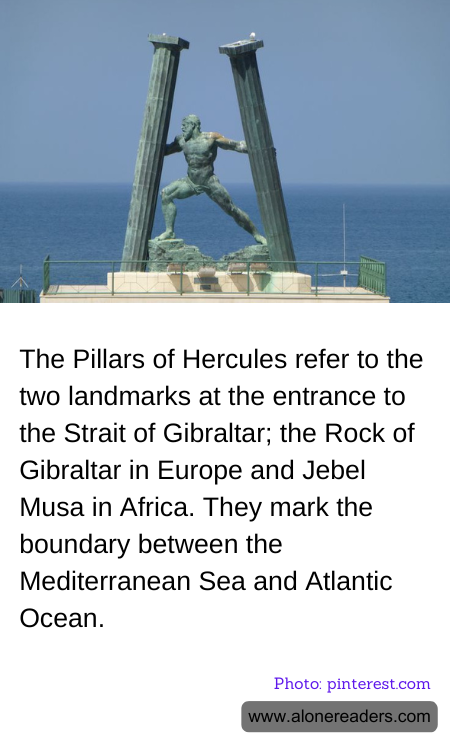
The Pillars of Hercules, an evocative name from classical mythology, represent the two promontories that flank the entrance of the Strait of Gibraltar. These geological landmarks, the Rock of Gibraltar on the northern side in Europe and Jebel Musa on the southern side in Africa, historically marked the limit to the known world of the ancient Greeks and Romans. Beyond these pillars lay the vast, unexplored Atlantic Ocean, a realm full of mysteries and dangers as per the mythological and geographical understandings of the time.
In myth, the pillars were supposedly created by Hercules (Heracles in Greek mythology) as part of his twelve labors. According to the legend, Hercules had to retrieve the Cattle of Geryon, a monstrous giant who lived on an island in the far west of the Mediterranean. To reach this island, Hercules used his immense strength to smash through the mountain that was once Atlas, thereby creating the Strait of Gibraltar and separating Europe from Africa. This mythic tale underscores the significance of the pillars not only as physical gateways but also as monumental testaments to the power and heroism associated with Hercules.
From a geographical perspective, these landmarks have long served as vital navigational points. During the age of sail, controlling the strait was of immense strategic importance as it allowed for control over maritime traffic between the Atlantic and the Mediterranean, crucial for trade and military endeavours. The ancient Roman saying "Non plus ultra" (nothing further beyond) was once inscribed as a warning to sailors and navigators about the dangers of venturing past the Pillars of Hercules into the unknown Atlantic Ocean. This cautionary sentiment reversed after the Age of Discovery when the Atlantic became a new frontier for exploration and trade.
Today, the Pillars of Hercules still hold significant geopolitical and symbolic importance. They represent not just physical demarcation points but also serve as cultural and historical bridges between two continents with rich and interwoven histories. Furthermore, the scenic beauty and biodiversity of the surrounding regions, including the waters of the strait itself, attract tourists and nature enthusiasts from around the world. As such, the Pillars of Hercules continue to be a profound reminder of our historical journey from myth to exploration, and the perpetual human quest to understand and traverse our natural world.
