More About This Card
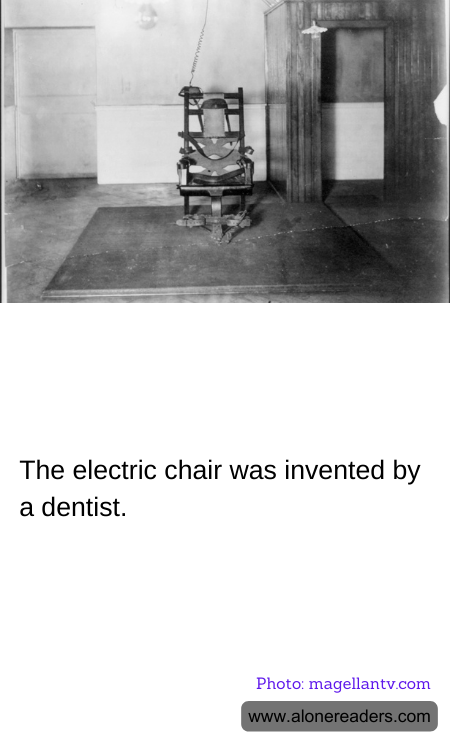
The electric chair, an invention that prompts images of early electrical experiments and severe penal methods, has a surprising origin linked to a profession typically associated with healthcare rather than punitive measures; it was invented by a dentist named Alfred P. Southwick from Buffalo, New York. Southwick, who had a background in mechanical dentistry and was an inventor, got the idea after witnessing a drunk man die quickly and seemingly painlessly after accidentally touching live electrical wires in 1881.
Intrigued by the potential for using electricity as a more humane alternative to the hanging method of capital punishment, Southwick began experimenting and promoting the concept. His medical and dental experience gave him insights into human physiology that he believed could be applied to developing a method of execution that was quick and, presumably, less painful. His work led him to advocate for the adoption of electrical technology in the execution process, which caught the attention of the New York state government.
Southwick’s contributions to the development of the electric chair were part of a broader movement during the late 19th century that sought to find more humane methods of execution. This period was marked by significant public and judicial debate over the methods used for capital punishment, with many suggesting that the existing methods were too barbaric and painful. Electricity, with its novelty and scientific allure, seemed to be a clean and efficient solution.
As a result of Southwick’s advocacy and experiments, the first electric chair was designed with his input, and it was first used in 1890 to execute William Kemmler in New York. This move marked a pivotal moment in the history of capital punishment in the United States. Despite the initial belief that electrical execution would be a more humane alternative, the first use of the electric chair was somewhat botched, leading to a gruesome and controversial event. Nevertheless, the electric chair became one of the standard methods of execution in the United States, predominately used throughout the 20th century.
Although the use of the electric chair has significantly declined after the introduction of lethal injection, the story of its creation remains a curious footnote in both the history of medicine and criminal justice. Alfred P. Southwick’s involvement as a dentist-turned-inventor in the realm of execution technology is a stark illustration of the sometimes strange intersections of different professional fields. The electric chair, while a product of innovation, also stands as a sobering reminder of society’s ongoing struggle to ethically balance the scales of justice and technology.