More About This Card
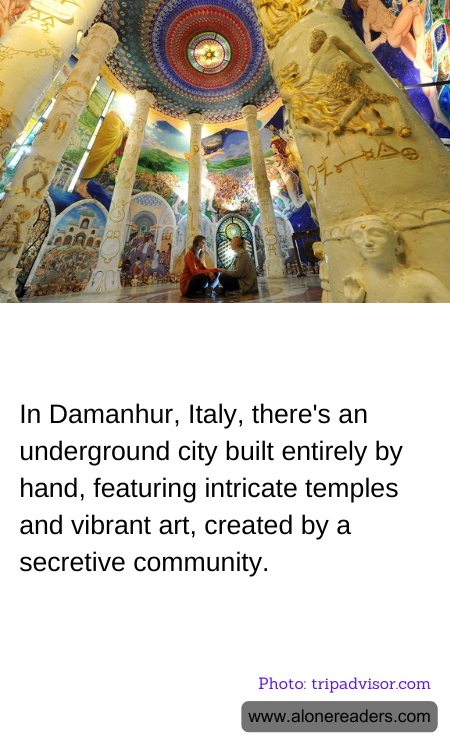
Nestled in the foothills of the Alps in northern Italy, Damanhur is a remarkable example of human creativity and spiritual dedication. This unique community, which started in the 1970s under the guidance of its founder, Oberto Airaudi (also known by his spiritual name, Falco Tarassaco), has meticulously carved a vast and splendid underground structure known as the Temples of Humankind. This underground city isn’t just a set of rooms and halls beneath the earth; it’s a complex network of temples richly decorated with mosaics, murals, and stained glass, all of which have been created entirely by hand by the community members themselves.
Damanhur’s Temples of Humankind is often referred to as the “eighth wonder of the world,” not only for its aesthetic beauty but also for its conception and construction. Work began secretly in the late 1970s without any official permission, and it was only in the 1990s, after being discovered by the authorities, that the community made formal arrangements to continue their work in accordance with local laws. The temples are a marvel of modern craftsmanship and ancient techniques, featuring several halls dedicated to different aspects of humanity and spirituality. These include the Hall of Water, reflecting the feminine principle and inner reflection, and the Hall of Earth, which celebrates the material world and our ability to shape it.
The art and architecture in the temples draw heavily from a variety of cultural and spiritual influences. The style ranges from Art Nouveau to classical, with symbolic elements that combine Celtic, Egyptian, and indigenous motifs. This cultural amalgamation reflects Damanhur's philosophical foundation that embraces universal human values, spiritual exploration, and connection with the Divine. Each painted wall, sculpted column, and mosaic floor piece tells a story, carefully crafted by the residents of Damanhur, who view their work as both a spiritual practice and a form of prayer.
Beside its astounding artistic and architectural achievements, Damanhur is a socially and environmentally engaged community. It functions on principles of sustainability, shared resources, and mutual support. The economy of Damanhur is community-driven, focusing on art, organic farming, and the production of renewable energy, which aligns with their respect for nature and ecological sustainability.
For visitors, Damanhur offers not just a glimpse into an exceptional artistic endeavor, but an experience of a community that thrives on creativity, spiritual pursuit, and closeness to nature. Although the community originally started as a small group, today it attracts thousands of visitors from around the world, drawn by both its mystical appeal and its example of communal living. However, the temples remain the heart of Damanhur, a symbol of what can be achieved when human beings live in close collaboration with each other and with nature.