More About This Card
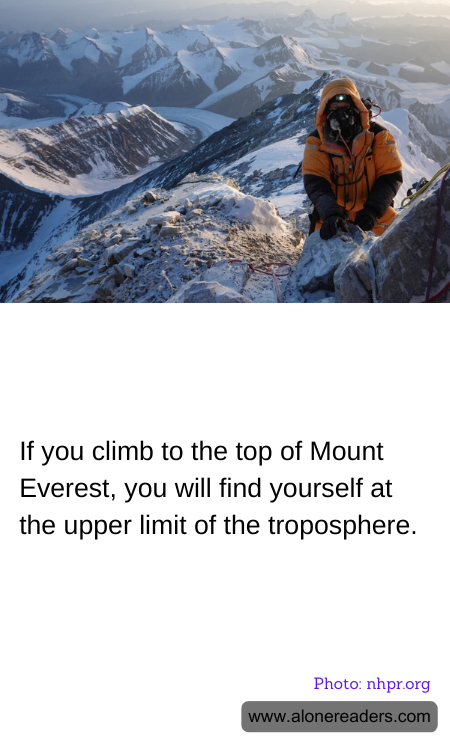
Climbing Mount Everest is an extraordinary endeavor, taking adventurers to the very extremities of Earth's atmosphere. Standing at approximately 29,032 feet, Mount Everest soars high into the sky, reaching the upper boundary of the troposphere. This region of the atmosphere is the lowest layer, where virtually all weather phenomena take place, illustrating the dynamic interplay of temperature, air pressure, and climatic conditions.
The troposphere starts at the Earth’s surface and extends upward to about 4-12 miles (6-20 kilometers). Remarkably, its height varies depending on geographical location and weather conditions. At the equator, it is thickest and thins out toward the poles. Mount Everest, located nearer to the poles and rising to such a formidable elevation, nearly touches the boundary of the troposphere and the stratosphere above it. Here, the air is exceedingly thin, containing less than one-third the oxygen available at sea level, which makes breathing laborious and limits physical exertion.
As one reaches these upper reaches of the troposphere, the environment becomes harsh and extreme. Temperatures can plummet to minus 60 degrees Celsius, and fierce winds whip across the barren landscape. This boundary layer above Everest is known among climbers as the “death zone,” due to the perilously low levels of oxygen and the severe weather conditions.
Furthermore, the effect on weather patterns and climatic conditions can be palpable at such a high elevation. The mountain itself influences local weather systems, often creating its own weather, which can change swiftly and unpredictably. This has profound implications for climbers, who must be highly skilled in interpreting and responding to these changes to increase their chances of a successful ascent and descent.
In essence, climbing Mount Everest offers more than just physical challenges; it brings climbers face-to-face with some of the most exciting and distinctive atmospheric phenomena on Earth. It serves not only as a testament to human endurance and spirit but also as a natural laboratory for observing and understanding our planet’s atmosphere at one of its most extreme limits. Climbing Everest is undoubtedly one of the ultimate encounters with the raw forces of nature.