More About This Card
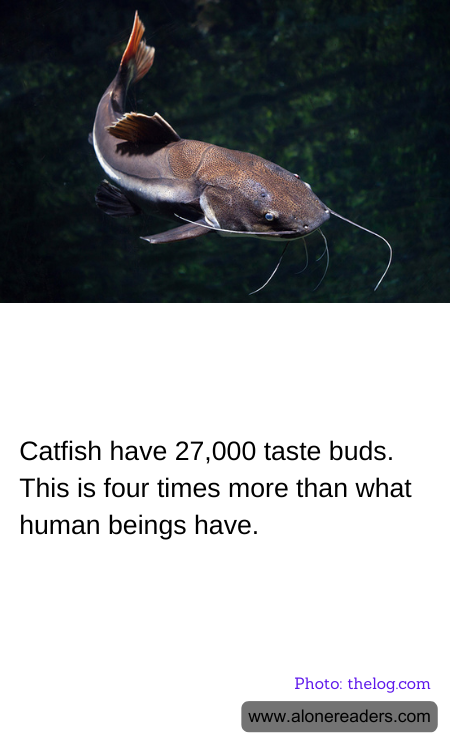
Catfish are remarkable creatures, particularly when it comes to their sense of taste. Unlike humans who have about 7,000 taste buds, catfish boast an impressive 27,000 taste buds. This incredible number is not only a fascinating trivia fact but also a crucial aspect of their survival and behavior in their aquatic environments.
The taste buds of a catfish are not confined to their mouths; they are distributed across the surface of their entire body, most densely packed on their whisker-like barbels. These barbels are used to explore the riverbed for food, effectively allowing the catfish to "taste" its way around, which is particularly useful in the murky, dark waters where these fish often dwell.
This advanced tasting system provides the catfish with a significant evolutionary advantage. By being able to detect even the slightest traces of chemicals in the water, catfish can locate food sources, avoid predators, and even sense the presence of other catfish. In muddy or nocturnal environments where visibility is low, taste becomes an essential sense for navigation and survival.
Furthermore, the ability to process such a wide range of sensory information through taste buds enables catfish to possess a highly nuanced sense of taste. This sensitivity helps them identify various types of food and determine its quality, which is crucial when the visual identification of food is impaired. It also plays a role in the social behavior of catfish, aiding them in recognizing the pheromones of potential mates or the presence of rivals.
In conclusion, the 27,000 taste buds of a catfish are not just a numerical superiority but a refined adaptation to their living conditions. This feature illuminates the complexity of aquatic life and underscores how species have evolved unique mechanisms to thrive in diverse and challenging ecosystems. Catfish, with their extraordinary sense of taste, stand as a testament to the remarkable adaptability and intricacy of nature’s designs.