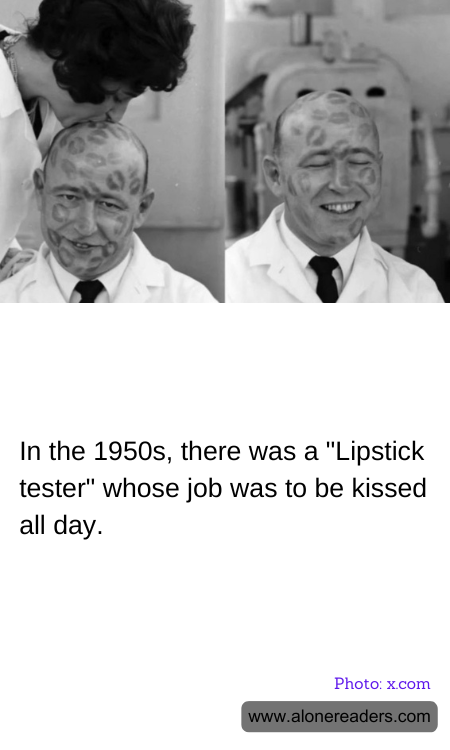
In the whimsical and evolving landscape of the 1950s job market, one of the more unusual and intriguing careers was that of a "lipstick tester." While it might sound somewhat fanciful, this role was actually quite significant in the cosmetics industry. During a time when the allure of glamour and beauty held a prized place in society, lipstick testers played a crucial role in ensuring that products not only looked appealing but also performed under close scrutiny.
The primary duty of a lipstick tester was not just to wear various shades of lipstick, but to engage in repeated acts of being kissed. These testers were predominantly employed by cosmetic companies eager to demonstrate their lipstick's durability and capacity to remain smudge-free, even when subjected to the direct contact that a kiss typically involves. This was important because, during the 1950s, lipsticks were adjusting formulations to resist wearing off, a marketing point that would appeal to the busy, modern woman of the era.
Men were often hired as the counterpart in these testing scenarios, charged with the task of kissing the testers to see how much lipstick would transfer from lips to skin or fabric. Such experiments were conducted under various conditions to simulate real-world situations that might lead to lipstick wear. It was a peculiar yet practical way to ensure that a lipstick could hold up to its claims of longevity and resistance.
Furthermore, beyond just testing staying power, these testers also provided feedback on comfort, texture, and even flavor. This comprehensive testing helped manufacturers in refining their products, making them more tailored to consumer desires and expectations.
Today, the profession of a lipstick tester as it existed in the 1950s is largely obsolete, owing to advances in technology and changes in product testing methodologies. Modern cosmetic testing has moved toward more technologically sophisticated equipment and techniques, such as artificial skin models or mechanical devices that simulate the pressure and motion of a kiss.
Though it might appear as merely a quirky job from the past, the role of a lipstick tester played a part in the broader narrative of how beauty products have evolved and how consumer goods were marketed during the mid-20th century. It underscores a point in time when the booming beauty industry was heavily invested in capturing the perfect balance between allure and practicality, a pursuit that continues in the cosmetic industry to this day.
