More About This Card
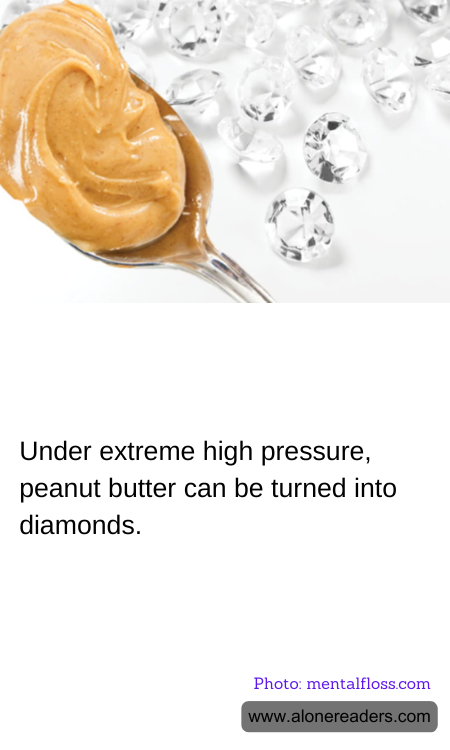
Turning peanut butter into diamonds might sound like a quirky experiment straight out of a mad scientist’s lab, but it essentially is rooted in principles of extreme physics and material science. Peanut butter, like many other carbon-rich materials, can be transformed under specific conditions, illustrating the intriguing ways in which carbon atoms can rearrange to form completely different materials.
The premise of this transformation is based on the fact that diamonds are nothing but a crystalline form of carbon. Naturally, diamonds are created over billions of years beneath the Earth’s surface under conditions of intense heat and pressure. This process forces carbon atoms to align in a unique crystal structure known as the diamond lattice, which gives diamonds their characteristic hardness and brilliance.
To replicate this in a lab, a starting material rich in carbon—like peanut butter—is required. Peanut butter is an interesting candidate as it is composed of about 20% carbon, primarily deriving from the fats and proteins it contains. The transformation process in a controlled laboratory environment involves subjecting the peanut butter to extreme pressures of approximately 5 gigapascals (more than 50,000 times atmospheric pressure) and temperatures above 2,000 degrees Celsius. This can be achieved using a device called a high-pressure press or a more sophisticated apparatus known as a diamond anvil cell, which allows for smaller but more precise experiments.
The pressure and heat essentially mimic the natural conditions that produce diamonds in the Earth’s mantle, stripping away other elements and pushing the carbon atoms close enough to bond in the diamond’s crystalline structure. However, it's important to acknowledge that the process isn’t particularly efficient or practical. The diamond that results is microscopic and hardly usable in jewelry. Moreover, it tends to be contaminated with other elements from the peanut butter, which can give it a more brownish hue, hardly resembling the clear and gleaming appearance of natural or synthetically produced diamonds typically used in ornamental jewelry.
While turning peanut butter into diamonds sounds fantastical and is a demonstration of human ingenuity in manipulating materials, it is more of a scientific curiosity than a practical method for diamond production. Instead, the experiment is a fascinating example of how extreme conditions can fundamentally change the structure and properties of everyday materials, offering insights into the behaviors of different forms of carbon and expanding our understanding of material science. Such experiments underscore the playful yet profound nature of scientific inquiry, showing that even the most ordinary substances can be transformed into something extraordinary under the right conditions.