More About This Card
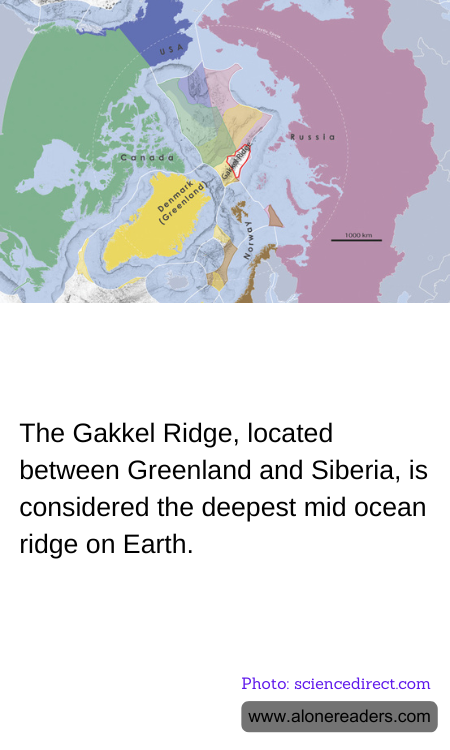
The Gakkel Ridge, a profound feature situated deep beneath the Arctic Ocean, runs between Greenland and Siberia and is noted as the deepest mid-ocean ridge on Earth. This underwater mountain range forms part of the boundary between the North American and Eurasian tectonic plates. Stretching over 1,800 kilometers, it has depths reaching more than 3,000 meters, distinguishing it not only by its size but also by the extreme conditions found there.
Discovered in detail during a scientific expedition in 2001, the Gakkel Ridge is intriguing for its slow spreading rate, which ranges from less than one centimeter to over one centimeter per year. This slow rate of geological activity is atypical for mid-ocean ridges, which are usually characterized by higher levels of volcanic activity and faster spreading rates. The Gakkel Ridge, however, does hint at surprisingly robust volcanic features despite its sluggish dynamics, with numerous volcanoes and hydrothermal vents that have been detected over the years.
The presence of these underwater volcanoes and the hydrothermal vents - which are akin to underwater geysers spewing hot, mineral-rich water - make the Gakkel Ridge a hotspot for studying extreme life forms. These ecosystems thrive in harsh environments devoid of sunlight, relying instead on chemosynthesis as a method of generating energy. This involves the use of sulfur and other minerals emitted from the vents to sustain life, offering valuable insights into biology's adaptability and the possibilities for life in analogous extreme environments, such as on other planets.
Moreover, the exploration of the Gakkel Ridge has significant implications for understanding Earth's geological processes and the dynamics of tectonic plate movements. Studying such a remote and inaccessible location involves sophisticated technology and international collaboration, highlighting the importance of global scientific cooperation in expanding our knowledge of the planet.
Despite the logistical and technical challenges associated with its exploration, the Gakkel Ridge continues to be a subject of great interest for geologists, biologists, and oceanographers alike. Each exploration campaign brings new discoveries that could not only redefine our understanding of life's capabilities but also enhance our understanding of Earth’s geological history and the complex processes that govern our planet.