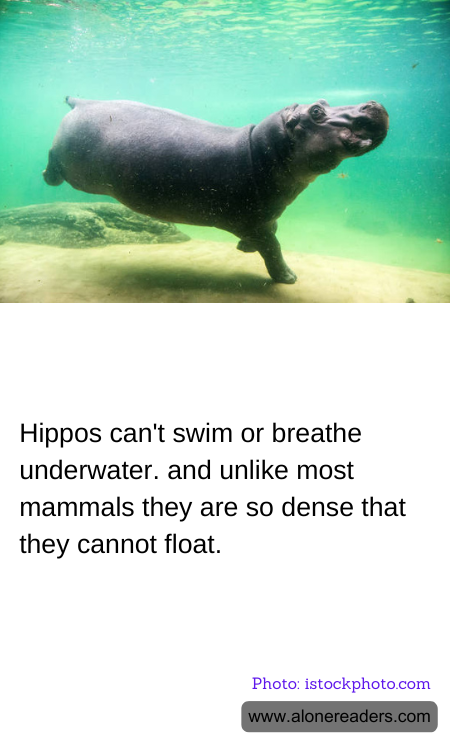
Contrary to popular belief, hippos cannot swim. Despite their life largely revolving around water, these massive creatures are not equipped with the ability to swim or float like most aquatic or semi-aquatic animals. Hippos, with their colossal size, spend a majority of their time in rivers and lakes of sub-Saharan Africa but they exhibit unique adaptations that differentiate them from other water-dependent animals.
Hippos are incredibly dense and heavy, which prevents them from floating. Instead of swimming, they navigate through water bodies by pushing off from the bottom. They walk or gallop along the riverbed in a graceful manner that seems like swimming. This underwater "walking" technique is aided by their specific body structure; their feet are broad, padded, and suited well for pushing off and moving along the soft riverbed.
Moreover, hippos cannot breathe underwater, and thus they need to surface every few minutes to breathe. Even though they spend up to 16 hours a day in water, they have to keep coming up for air. The placement of their eyes, ears, and nostrils on the top of their heads allows them to breathe and look out for threats while mostly submerged. Impressively, hippos have a built-in reflex that enables them to rise up and take a breath while sleeping without waking up.
Living in water helps the hippos maintain their massive body temperature and protects their sensitive skin from the sun while also providing them refuge from predators. The water environment suits their needs perfectly despite their inability to actually swim. This unique adaptation of ‘water-walking’, combined with their ability to stay submerged for several minutes, underscores the remarkable ways in which animals can adapt to their habitats, displaying behaviors that might seem counterintuitive at first glance. Hippos are quite the anomaly when it comes to mammalian relation to water: they are perfectly adapted to life in and around water bodies, yet they lack the ability to swim or float, challenging our common perceptions of how aquatic animals survive and thrive.
