More About This Card
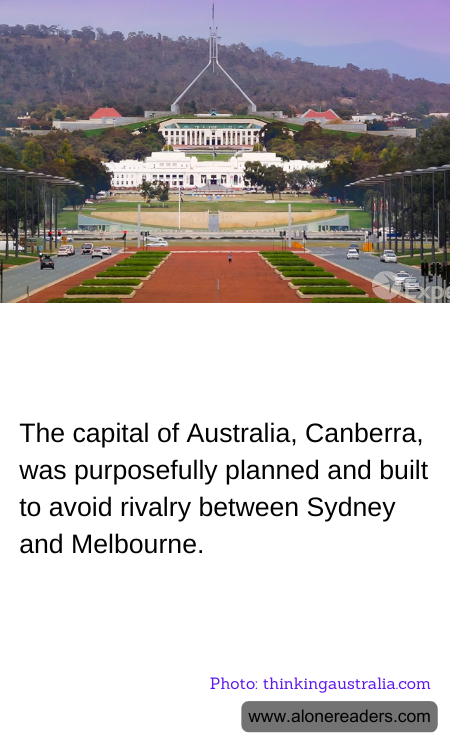
Australia's capital, Canberra, is a remarkable example of meticulous urban planning and strategic geographical positioning, designed primarily to serve as a neutral site amidst an intense rivalry between Sydney and Melbourne. In the early 20th century, as the newly formed Federation of Australia considered the location for its capital, the cities of Sydney and Melbourne were each vying to be recognized as the nation's foremost city. Both were prominent urban centers; Sydney was noted for its bustling harbor and commercial prowess, whereas Melbourne was celebrated for its cultural vitality and established infrastructure.
The decision to build a new city altogether was a deliberate move to sidestep this intercity competition and promote unity within the young federation. After considerable debate, the decision was made, facilitated by the passage of the Seat of Government Act in 1908, which stipulated that the new capital would be located in New South Wales but at least 100 miles from Sydney. The site for Canberra was chosen for its strategic location, temperate climate, and aesthetic appeal.
American architect Walter Burley Griffin won a global design competition and designed Canberra in 1911, with a vision that blended natural landscapes with urban architecture. His plan featured geometric motifs like circles and hexagons, and proposed a garden city that integrated the surrounding natural bushland into the city’s layout. This design was pivotal in the development of Canberra, emphasizing spaciousness and natural beauty which was a distinct departure from the denser, more industrial atmospheres of Sydney and Melbourne.
As the construction of Canberra progressed, it epitomized not only a compromise between rivals but also an innovation in urban design. Canberra's layout included broad avenues, large public buildings, and open spaces, intended to reflect the democratic values and progressive spirit of the nation. The city evolved into both a political hub and a cultural center, with institutions such as the Australian National University, the National Gallery of Australia, and the Australian War Memorial.
Today, Canberra stands as a testament to successful urban planning and the power of strategic compromise. By transcending regional rivalries, it has served to symbolize national unity and remains a unique embodiment of Australia’s identity and aspirations.