More About This Card
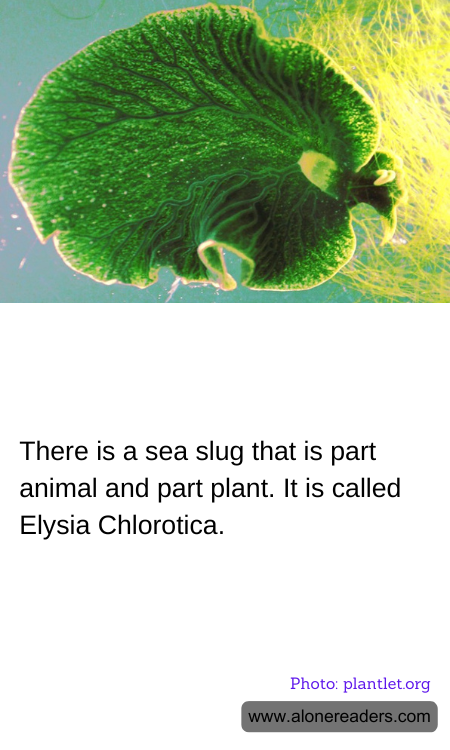
Elysia chlorotica, a remarkable sea slug, has intrigued scientists with its ability to incorporate plant-like characteristics into its animal physiology. Commonly referred to as the eastern emerald elysia, this sea slug is found along the east coast of the United States and Canada, primarily in marshes and shallow waters where its food source, the algae Vaucheria litorea, is abundant.
What sets Elysia chlorotica apart from other organisms is its unique method of survival, particularly its ability to perform photosynthesis. Typically, photosynthesis is a trait associated with plants, not animals. This process involves converting sunlight into energy, using it to transform carbon dioxide and water into glucose and oxygen. The sea slug accomplishes this by stealing chloroplasts, the organelles in plant cells that carry out photosynthesis, from the algae it consumes. This phenomenon is known as kleptoplasty.
Kleptoplasty allows Elysia chlorotica to survive for months solely by the energy produced from photosynthesis, especially during periods when food is scarce. After ingesting the algae, the slug meticulously extracts and incorporates the chloroplasts into its own cells. Intriguingly, it maintains the chloroplasts in a functional state much longer than would be expected. Research suggests that the slug’s cells may provide the necessary proteins and a conducive environment for the stolen chloroplasts, enabling them to continue functioning long after they are absorbed.
This unique ability effectively makes Elysia chlorotica a solar-powered organism, capable of deriving energy directly from sunlight, similar to plants. Its svelte, leaf-like body, which is a vibrant green due to the presence of chloroplasts, also aids in maximizing sunlight absorption, further simulating a plant-like existence.
The study of Elysia chlorotica provides valuable insights into evolutionary biology and symbiotic relationships. This sea slug exemplifies an extraordinary adaptation where traditional lines between plant and animal blur, suggesting a much more complex series of interactions in nature than previously understood. Moreover, the mechanics of how Elysia chlorotica retains and keeps chloroplasts functional suggests potential for biotechnological applications, including advancements in the fields of energy production and bioengineering.
Elysia chlorotica not only challenges our perception of the capabilities of life forms but also is a testament to the intricacy and interconnectedness of life on Earth, raising profound questions about evolution, adaptation, and survival. As research continues, this small but mighty sea slug may hold the secrets to unlocking new sustainable energy methods or reveal deeper insights into cellular function and longevity.