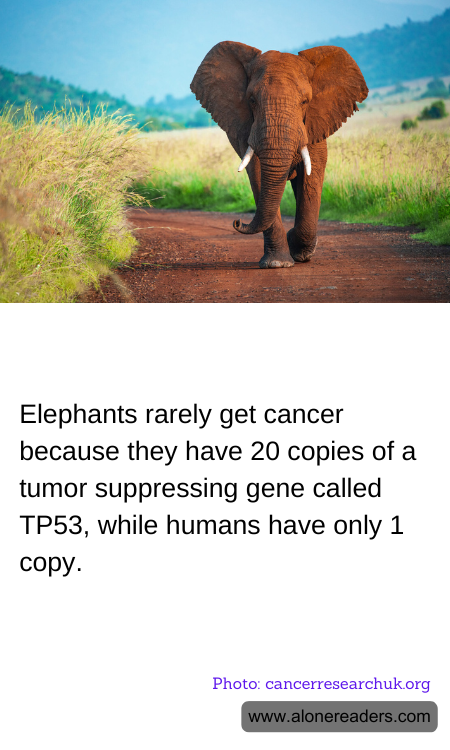
More About This Card
Elephants are remarkably resilient to cancer, a fact that has intrigued scientists and researchers. This resistance is largely attributed to their possession of numerous copies of a gene known as TP53, a powerful tumor suppressor. Humans, in contrast, carry only a single copy of this gene, which partly explains the higher incidence of cancer in our species compared to elephants.
TP53 works by monitoring the DNA within cells and responding to abnormalities typically associated with cancer development. It either repairs the faulty DNA or triggers cell death if the damage is beyond repair, thus preventing the proliferation of potentially cancerous cells. In elephants, the presence of 20 copies of TP53 provides a robust mechanism for catching and correcting cell defects, significantly enhancing their defense against cancer.
This discovery has broad implications for cancer research and treatment. Understanding how elephants' TP53 genes confer such strong protection against cancer could lead to breakthroughs in human cancer therapies. Researchers are exploring how elephant-derived TP53 might be used to beef up the cancer-fighting capabilities of human cells or to design treatments that mimic this effect.
Moreover, the elephant's cancer resistance highlights the role of genetics in oncology and helps in the refinement of genetic-based therapeutic techniques. It serves as a natural model of effective cancer resistance, guiding scientists in the development of strategies to enhance the human body's natural cancer-fighting abilities. This line of research not only demonstrates the interconnectedness of all living organisms but could potentially lead to revolutionary advancements in how we prevent and treat cancer in humans.