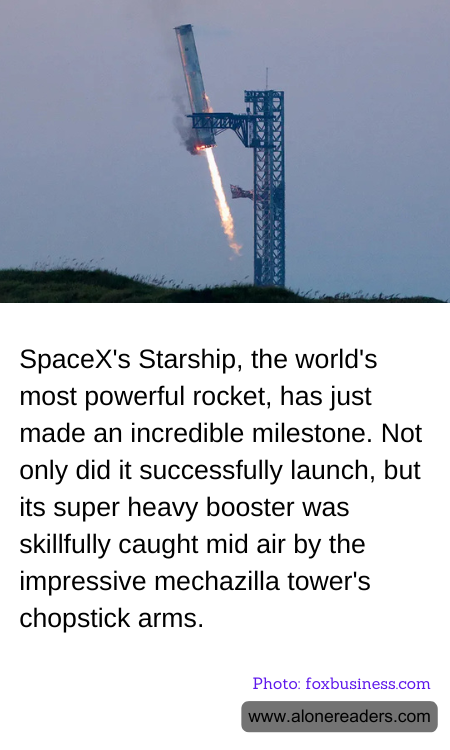
SpaceX has once again pushed the boundaries of aerospace technology with its Starship rocket, the most formidable launch vehicle ever constructed. This colossal rocket successfully launched and, in a groundbreaking maneuver, its Super Heavy booster was caught midair by the innovative Mechazilla tower's "chopstick" arms. This technique marks a significant leap forward in reusable rocket technology, potentially reducing the cost and increasing the frequency of space travel.
The design of the Starship, capable of carrying humans to Mars and beyond, is central to Elon Musk’s vision for interplanetary travel. The Super Heavy booster, the lower stage of the Starship, plays a crucial role in propelling the spacecraft out of Earth's gravitational pull. Traditionally, rocket boosters are expended during launch or undergo complicated recovery procedures involving drone ships or land-based returns. However, SpaceX’s method of catching the booster midair is an innovative approach, safeguarding the booster from harsh sea conditions and avoiding the risks and delays of ocean recovery.
The Mechazilla tower equipped with chopstick-like arms is designed to precisely align and catch the booster as it returns to the launch site. This strategy aims not only to protect critical hardware but also to streamline the refurbishment and reuse of the booster, thereby optimizing rapid reusability. This successful catch is crucial, offering tangible proof that such operations can be accomplished reliably and safely.
This achievement propels SpaceX closer to the realization of cost-effective, sustainable space exploration. The potential to launch, recover, refurbish, and relaunch the Starship's booster on an unprecedented scale could ultimately reduce the per-mission cost of reaching orbit and beyond. With future missions on the horizon, including crewed flights around the moon and to Mars, this breakthrough underscores a vital component of Musk’s broader strategy to make human life multiplanetary.
Overall, this landmark achievement not only advances SpaceX's own capabilities but also sets a new benchmark for the aerospace industry, promising a future where space travel could become as routine as air travel, redefining humanity's place in the cosmos.
