More About This Card
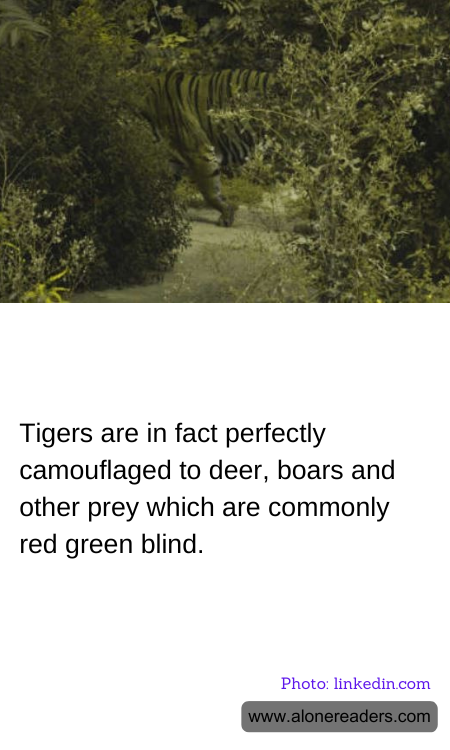
In the complexity of the natural world, the effectiveness of a tiger's camouflage is a striking example of evolutionary adaptation. Tigers, with their iconic orange, black, and white striped coats, might seem vividly conspicuous to human eyes. However, to their prey, such as deer and boars, they are incredibly difficult to spot. This is largely because these animals are typically red-green color blind, a condition where red and green are perceived as similar tones that blend together.
The color blindness in prey species like deer and boars means that they primarily see shades and tones rather than distinct colors. In their vision, the orange fur of the tiger blends seamlessly with the greenery of the forest or the brown tones of the woodland during autumn. This blending effect is enhanced by the vertical striping of the tiger's fur, which mimics the vertical lines of tall grasses and tree trunks in dense forests, breaking up the animal's outline.
Tigers' stripes offer another level of visual disruption. Each tiger's stripes are unique in their patterning and provide an excellent disruption technique, fragmenting their visual appearance. This means that even if prey animals notice a part of the tiger, they may not necessarily recognize it as a predator, as the stripes disrupt the outline and continuity of its shape, making it hard to distinguish as a single entity.
Additionally, tigers are primarily ambush predators, leveraging their camouflaged appearance to get close to their prey before launching a rapid attack. The strategy of stalking close to the ground, combined with their striped camouflage, allows them to approach their target with a significant element of surprise.
This camouflage is so critical to their hunting success that it has been fine-tuned through natural selection over millennia. Those tigers whose camouflage was most effective in a particular environment would have been more successful in reproducing, thus passing on their genes, including those for their specific camouflaging traits.
In summary, while tigers appear boldly colored and clearly patterned to human eyes, they are perfectly adapted to the perceptual limitations of their primary prey. This mismatch between human and prey animal perception is a fascinating insight into how camouflage and predator-prey dynamics play out in the wild, driven by the evolutionary pressures of survival and reproduction.