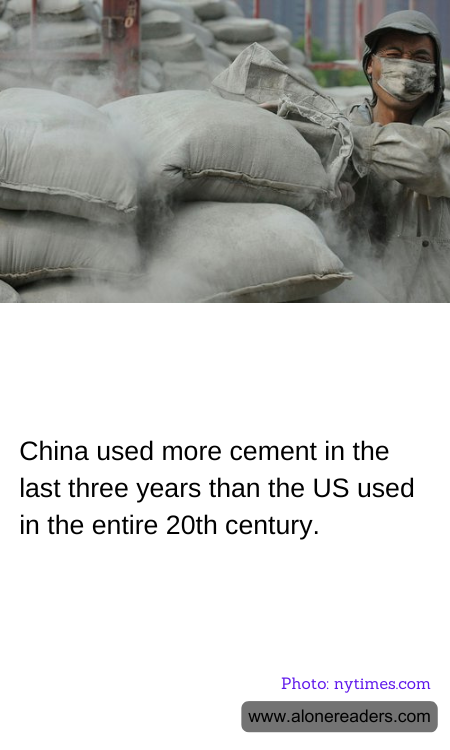
The staggering scale of urban and infrastructural development in China over the past few years sheds light on some extraordinary statistics. Among these, the fact that China has used more cement in the last three years than the US did in the entire 20th century stands out as particularly indicative of the rapid pace at which the country is developing. This statistic is often cited to underline the magnitude of China’s construction boom which has largely been propelled by the country's urbanization and modernization initiatives.
The comparison with the United States, a country known for its massive infrastructural endeavours such as the interstate highway system and numerous large-scale building projects, highlights the intensity and speed of construction across Chinese cities. From sprawling urban centers to monumental infrastructure projects like high-speed rail networks and numerous airports, the demand for cement in China has been unprecedented. Cement, being a fundamental material in construction, reflects broader trends in the construction sector and, by extension, in economic priorities and urban planning.
The implications of this level of cement consumption are manifold. Environmentally, the production of cement is energy-intensive and significantly contributes to CO2 emissions. China’s massive consumption thus raises concerns about the environmental sustainability of such rapid development, even as the country pledges to reach carbon neutrality by 2060. The sheer volume of construction also raises questions about the quality of life in cities, urban density, and the sustainability of such rapid urban expansion.
Furthermore, this statistic serves as a reflection of China's shift from a predominantly agrarian society to an industrial and urban one, at a pace and scale the world has rarely seen. The government’s focus on infrastructure as a means of stimulus for the economy can also be seen in this light—it’s not just about meeting the needs of urbanization, but also about fueling economic growth through construction and development projects.
For global cement and construction markets, China's intense usage has substantial impacts, influencing global prices and demand patterns, and driving innovation in building technologies and materials that could be more sustainable or efficient. This rate of consumption poses both challenges and opportunities—the challenge of managing environmental impacts and the opportunity to lead in developing more sustainable construction practices.
Thus, while the figure concerning China's consumption of cement is a testament to its rapid growth and ambitious infrastructural goals, it also serves as a reminder and a call to action regarding the environmental and sustainability issues that come with such a monumental developmental pace.
