More About This Card
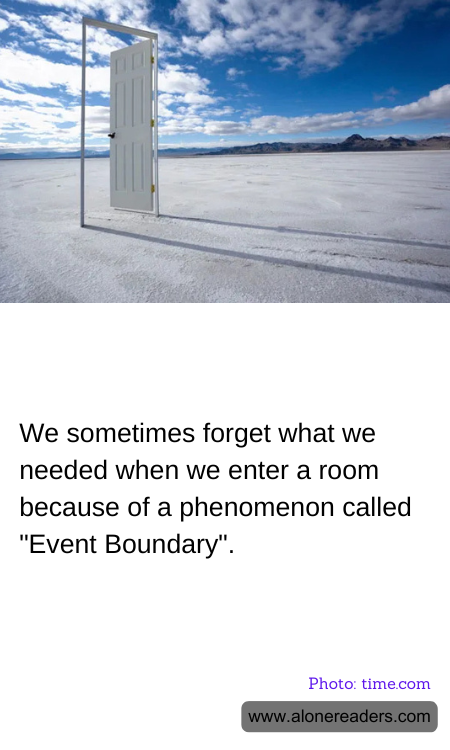
The phenomenon of forgetting what we needed the moment we enter a room is known as the "Event Boundary" effect. This intriguing psychological occurrence is a facet of our episodic memory's function, wherein the act of passing through a doorway signifies a boundary between different environments, prompting our brains to file away the thoughts and memories from the previous room and prepare to create new ones.
Scientifically, this effect is tied to the way our brains segment experiences and can be linked to the way cognitive scientists understand the architecture of memory. According to the "Event Segmentation Theory," the human brain processes experiences in distinct "events" or chunks. As we navigate through different physical environments, our brain views doorways as cues to conclude the previous event and begin processing a new one. Each event is stored in our memory as a separate entity, which sometimes makes it difficult to recall the thoughts or intentions we had just moments before crossing an event boundary.
Neurologically, this segmentation is attributed to spatial updating, which involves the hippocampus, a region of the brain closely associated with memory formation and recall. As we traverse through doorways, our hippocampus updates our current context, resetting and effectively clearing what might be considered as working or short-term memory in anticipation of new information pertinent to the new space.
Researchers have conducted experiments that demonstrate this effect, one of which involves participants performing memory tasks while entering different rooms or simply crossing through doorways within the same room. The results consistently show a decrease in memory performance after crossing a threshold compared to those who performed tasks staying within the same room.
Understanding the Event Boundary effect has practical implications, especially in designing more memory-friendly environments in workplaces, homes, and educational settings. It also sheds light on everyday strategies to mitigate forgetfulness, such as maintaining a line of thought consciously when moving between rooms or spaces or using physical prompts like notes or objects that help carry a train of thought across these boundaries.
Despite its occasional inconvenience, the Event Boundary effect is a testament to our brain's incredible capability to organize and manage vast amounts of information relevant to navigating through varied spaces and circumstances in our daily lives.