More About This Card
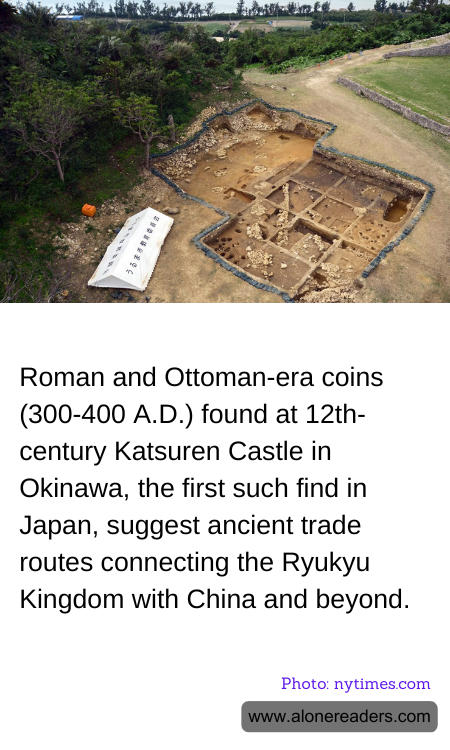
The discovery of Roman and Ottoman-era coins dating from 300-400 A.D. at the 12th-century Katsuren Castle in Okinawa, Japan, is a remarkable archaeological find that redefines our understanding of early global trade networks. This first-ever discovery of such antiquities in Japan suggests that the Ryukyu Kingdom, of which Okinawa was a central part, had interactions that extended well beyond its traditional sphere of influence in East Asia.
Katsuren Castle, known historically for its strategic importance in the Ryukyu trade routes with China and Korea, now evidences connections to the West much earlier than previously documented. These coins, likely to have been minted during the reigns of Constantine the Great and his successors in Rome, and similarly aged coins from the later Ottoman period, pinpoint to a far more extensive range of trade and cultural exchange. The presence of these coins across such vast distances indicates that trade was not just bilateral among adjacent civilizations but spanned continents.
Archaeologists speculate that the coins could have reached Okinawa through various means. One possibility is that they were part of the tributary and gift-exchanging network that flourished during that era, a common practice among kingdoms to strengthen alliances. Another theory suggests that the coins might have arrived via the Silk Road, underscoring the Ryukyu's role not just as a peripheral participant in regional trade but as a hub in the vibrant maritime networks that connected East and West.
Such findings not only illuminate the historical depth and complexity of the Ryukyu Kingdom's international relations but also highlight the blending of cultures during a period when such interactions are generally assumed to have been limited. This scrutiny into trade dynamics provides a nuanced narrative of the movement of goods, ideas, and currency, showcasing a globalized world long before the term was coined. As the detailed examination of these coins and their origins continues, they are poised to offer further insights into the far-reaching tendrils of ancient trade and cultural exchange shaped by the movements of empires and economies across distances previously unimagined.