More About This Card
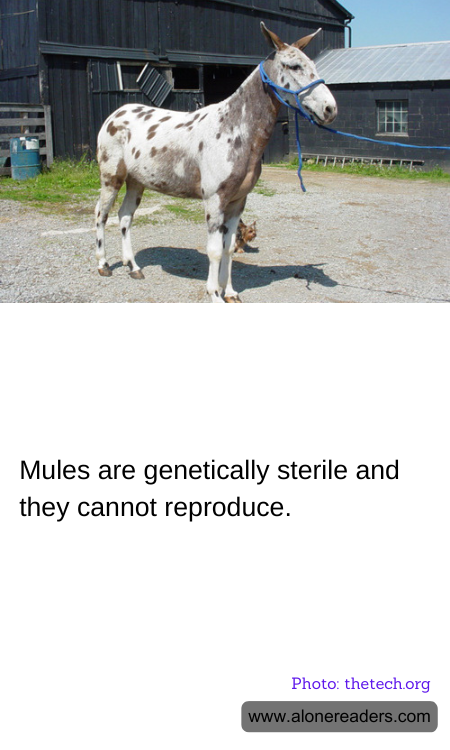
Mules, the offspring of a male donkey and a female horse, occupy a unique niche in the animal kingdom due to their hybrid vigor and distinctive blend of characteristics from both parents. These animals inherit the strength, patience, and surefootedness from the donkey side, while gaining the size, speed, and general appearance from the horse side. This combination makes mules exceptionally valuable for tasks such as farming, trekking, and transport, particularly in challenging terrains.
Despite these desirable traits, mules come with a significant biological limitation: they are almost always sterile. This sterility is primarily due to differences in the chromosomal contributions from each parent. Horses have 64 chromosomes and donkeys have 62 chromosomes. Mules, inheriting half of each parent's chromosomes, end up with 63 chromosomes, an odd number that cannot evenly divide during gamete production (formation of sperm and eggs). The uneven chromosome number results in unbalanced gametes, which generally leads to the inability to produce offspring.
The odd number of chromosomes disrupts the pairing process during meiosis, the type of cell division that results in the production of gametes. In organisms with an even number of chromosomes, each chromosome pairs up neatly with its counterpart from the other parent. However, in mules, one chromosome lacks a pair, leading to reproductive issues. Typically, these misaligned chromosomes lead to errors in genetic material distribution during the formation of sperm and eggs, resulting in infertility.
Although very rare exceptions exist — with a handful of documented cases where female mules have given birth — these incidents are extremely uncommon and tend to involve unusual or atypical genetic circumstances. For all practical purposes and common understanding, mules are considered sterile animals.
The sterility of mules has an agricultural and economic impact as well. Since mules cannot reproduce, each new mule must be purposefully bred from a horse and a donkey. This requires maintaining populations of both parent species and managing breeding programs to produce the required mules, contrasting with naturally breeding populations of other working animals like horses and donkeys themselves.
Despite their inability to reproduce, mules remain highly valued for their durability, temperament, and utility, particularly in regions and industries where their particular set of skills is crucial for either transportation or agricultural activities. This enduring usefulness underscores the fascinating interplay of genetics and practical utility that mules represent. Thus, while they are a genetic dead-end, their role in human society and their contributions to various sectors continue to make them an indispensable animal.