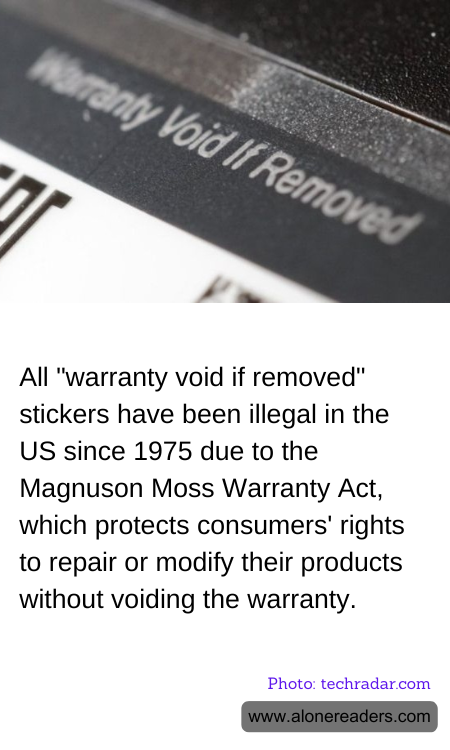
In the United States, consumer rights concerning product repairs and modifications are protected under the Magnuson-Moss Warranty Act, passed in 1975. This federal law was designed to ensure transparency and fairness in the warranties of consumer goods. Under this act, manufacturers can't legally void a warranty simply because the consumer has removed a "warranty void if removed" sticker or has chosen to use third-party parts and services for repairs.
The act affirms that warranties must be clearly written and must not contain deceptive or unfair terms. One of the significant stipulations is that it prohibits manufacturers from binding the warranty to the exclusive use of its own branded parts or services unless the manufacturer provides the parts or services for free or has received a waiver from the FTC. This means that the often-seen "warranty void if removed" stickers are not only misleading but legally unenforceable, as they imply a restriction that directly conflicts with the law's provisions.
This legislation is particularly vital in supporting the "right to repair" movement, which advocates for consumer rights to repair and modify their own electronic devices and other products. The ability to fix and upgrade devices without fear of losing warranty coverage not only promotes sustainability by extending the lifespan of products but also offers consumers more control over their purchases.
However, awareness and enforcement of these rights under the Magnuson-Moss Warranty Act can sometimes be lacking, both among consumers and businesses. Consumers often acquiesce to the terms dictated by manufacturers because they are not aware that some clauses in the warranty terms could be considered illegal under this act. Therefore, understanding and asserting these rights is crucial for all consumers, especially as technology and consumer goods evolve. Moreover, continuing legislative efforts and advocacy are essential to ensure that consumer rights are both protected and respected, keeping in pace with new market trends and technological innovations.
