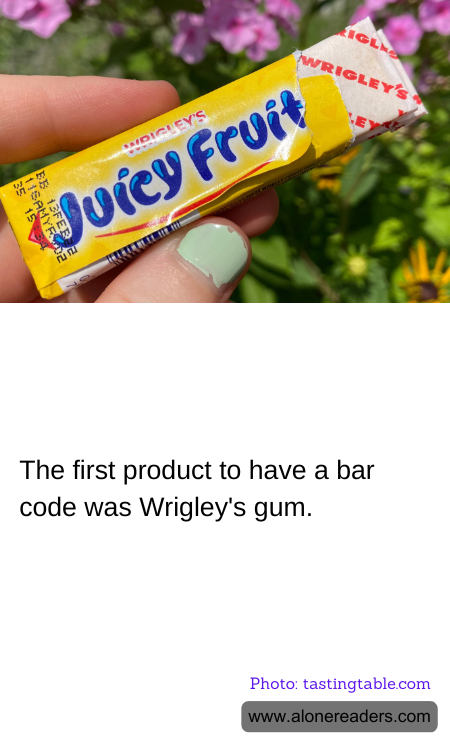
The bar code, a revolutionary technology that transformed global commerce, made its debut in a rather commonplace way—on a pack of Wrigley's gum. On June 26, 1974, at a Marsh Supermarket in Troy, Ohio, a cashier scanned a 10-pack of Wrigley’s Juicy Fruit gum, marking the first use of a Universal Product Code (UPC) in a commercial setting. This historic scan signaled the beginning of an era that would fundamentally change how businesses track inventory and handle sales transactions.
Developed to help speed up the checkout process and improve inventory management, the UPC is a series of black bars and white spaces that represent numbers readable by a scanner. This system was designed by George Laurer, an engineer at IBM, who devised a code that could be easily printed on products and quickly read by a scanner. The adoption of bar codes eliminated the need for manual entry of prices, significantly reducing checkout times and human error in businesses across numerous industries.
The Wrigley’s gum pack now resides in the Smithsonian Institution's National Museum of American History as a testament to this pivotal moment in retail history. The impact of Laurer’s invention has been profound and widespread, influencing not only the retail sector but also logistics, healthcare, and many other fields that rely on tracking and managing items efficiently. Beyond merely speeding up sales transactions, bar codes have enabled more sophisticated data analysis and inventory management, helping businesses optimize their operations and better understand consumer behavior.
Today, variations of Laurer’s original linear bar code, such as QR codes and RFID tags, continue to build on this legacy of innovation, further integrating digital technology into everyday commerce. From a stick of gum to comprehensive digital systems, the evolution of bar coding technology continues to drive efficiency and connectivity in the global market.
