More About This Card
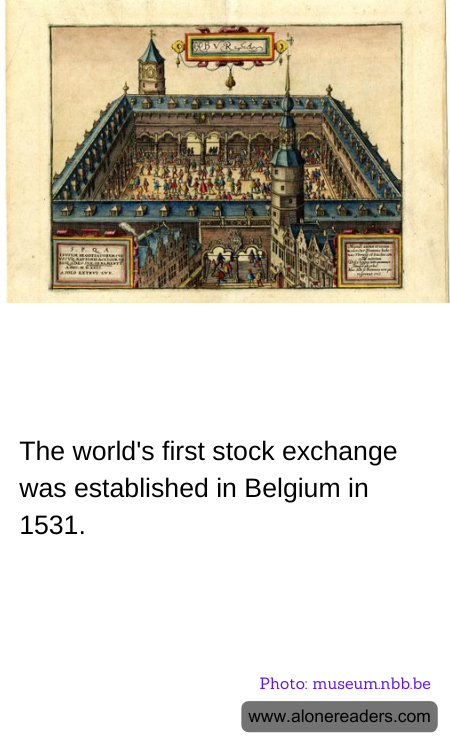
The origins of the stock exchange can be traced back to 1531 in Belgium, when the first known exchange was established in Antwerp. This pioneering platform laid the foundation for the modern stock markets that play a crucial role in today's global economy. In the 16th century, Antwerp was a bustling commercial hub where merchants from various parts of Europe converged. The establishment of the stock exchange was a response to the growing need for a structured environment where business securities could be traded.
The exchange in Antwerp primarily dealt with promissory notes and bonds. It wasn't like the stock exchanges we see today with shares of companies being traded. Instead, it focused on the trading of debt, representing investments in governmental or commercial ventures. This early form of the stock exchange provided a way for individuals to invest in various projects and for entities to raise funds for their activities. For the first time, investors could trade securities among themselves rather than directly with the issuers of those securities.
This system significantly contributed to the development of capital markets. It introduced concepts such as risk distribution and investment diversification. As these financial instruments evolved, they became increasingly important for the growth of international trade and the economic development of nations.
Following Antwerp's lead, similar exchanges soon sprang up in other trading centers, including Amsterdam, which established a more recognizable stock exchange in the early 17th century. Amsterdam's exchange added the innovation of trading in company stocks, including those of the Dutch East India Company, one of the first publicly traded companies. This evolution marked a significant expansion in the nature and scope of stock exchanges.
Today, stock exchanges are central to the global financial system, facilitating the raising of capital by companies, providing opportunities for investment, and contributing to economic growth. The concept that started modestly in a Belgian city has transformed into a complex and integral part of the world's economic infrastructure, affecting millions of people and influencing the economic policies of countries worldwide. Despite the evolution and changes in technology and the regulation of financial markets, the basic principles established in Antwerp remain at the core of trading practices today.