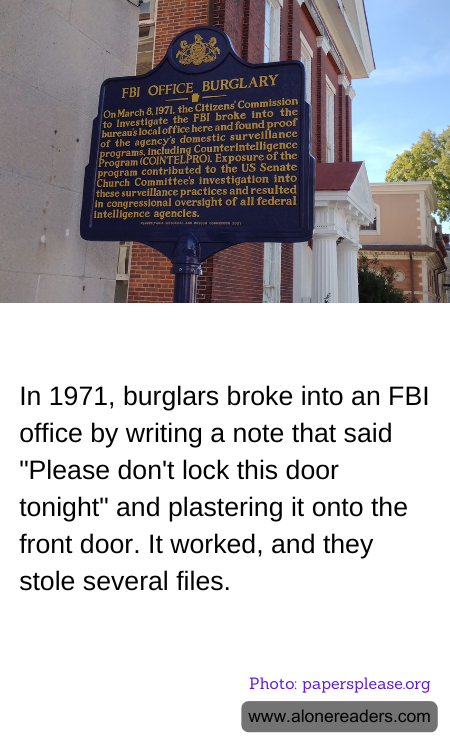
In a daring and audacious act of defiance against government surveillance practices, a group of activists orchestrated one of the most significant breaches of the FBI in 1971. The perpetrators were part of an activist group displeased with the FBI's domestic activities, particularly those directed by J. Edgar Hoover. Their target was an FBI office in Media, Pennsylvania, which they believed harbored crucial documents that could expose unwarranted agency operations.
The plan was both simple and surprisingly effective. The burglars, aware of the high risks involved in breaking into a federal building, concocted a plan to ensure the door to the office was conveniently unlocked for them. Their strategy? They placed a note on the door that read, "Please don't lock this door tonight." Remarkably, this straightforward tactic worked. It seems those responsible for securing the building at the end of the day adhered to the note’s request, leaving the locks disengaged which granted the burglars unhindered access into the office.
Once inside, the burglars made away with numerous files. These documents, once leaked to the public, initiated a nationwide uproar. The stolen files disclosed the extent of the FBI's Counter Intelligence Program (COINTELPRO), which had been involved in spying on, infiltrating, and disrupting American political organizations that were considered subversive. The revelations included surveillance and discrediting of civil rights and feminist organizations, among others, thereby broadening public discourse around government accountability and infringing civil liberties.
The fallout from the stolen FBI files triggered significant reforms within the agency and across government surveillance policies more broadly. Oversight committees were established, and prior untouchable corners of the government were subjected to public scrutiny. The event not only raised fundamental questions about the balance between national security and individual rights but also acted as a catalyst for the formation of newer policies designed to ensure that federal agencies respected the constitutional rights of the American populace.
Decades later, the 1971 FBI office break-in remains a compelling reminder of the power of civilian oversight and the importance of transparency in governmental operations. It's recognized not only for its audacity but as a pivotal moment in the narrative of civil liberties in the United States, underscoring the continuous need for vigilance in the protection of democratic values from potential overreach by those in power.
