More About This Card
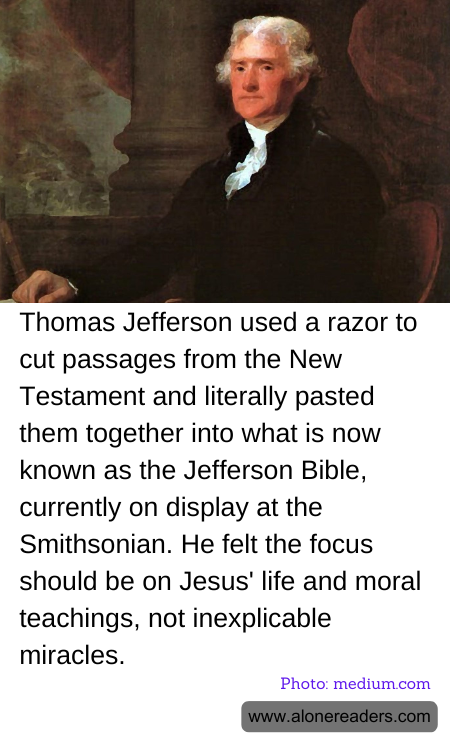
Thomas Jefferson, the third President of the United States, undertook an extraordinary personal project that reflected his complex views on religion and philosophy. Known for his Enlightenment-influenced intellectual bent, Jefferson embarked on creating his version of the New Testament, which later became known as the Jefferson Bible. His profound interest in the teachings of Jesus, as well as his skepticism towards the supernatural aspects of the New Testament, led him to produce a work focused solely on Jesus' moral teachings.
Using a razor, Jefferson meticulously cut out passages from copies of the New Testament, excising all supernatural events and miracles reported in the texts. His editing omitted sections such as the Resurrection, the Virgin Birth, and Jesus' miracles, which he believed were later additions that did not reflect the core moral philosophy of Jesus Christ. Instead, Jefferson's compilation highlighted what he considered to be the genuine ethical teachings and parables of Jesus, laying them out in a coherent and sequential manner. This effort was not intended for publication but was rather a private endeavor, aimed at clarifying and purifying religious doctrine to align with his rationalist outlook.
Jefferson's version of the New Testament was completed around 1820 and was titled "The Life and Morals of Jesus of Nazareth." It demonstrated his commitment to the idea of a moral philosophy devoid of what he viewed as the mysticism and superstitions of orthodox Christianity. Jefferson’s Bible thus offers a unique lens into the mind of one of America’s founding fathers, showcasing his efforts to reconcile his personal beliefs with the religious ideologies of his time.
Today, the Jefferson Bible is preserved and displayed at the Smithsonian Institution, serving as a historical artifact that illuminates the religious and philosophical beliefs of an essential figure in American history. It not only exemplifies Jefferson's intellect and his approach to religion and ethics but also serves as a reflection of the broader theological and philosophical debates that shaped the early United States. For modern readers and historians, the Jefferson Bible provides not only a window into Jefferson’s thoughts but also into the era's challenges in grappling with faith, reason, and the separation of church and state.