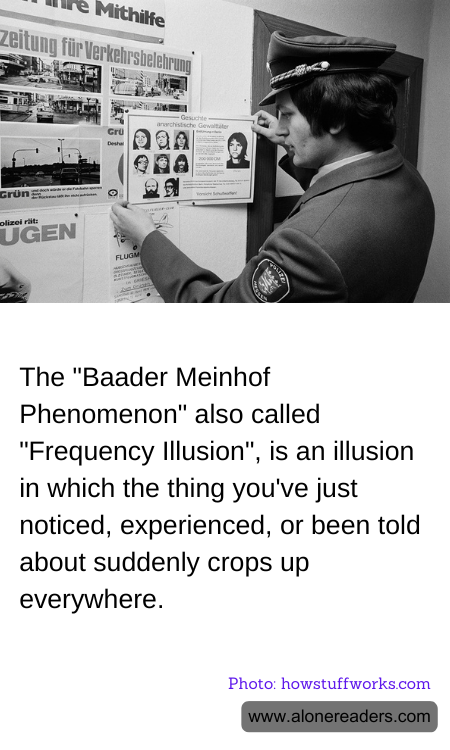
The Baader Meinhof Phenomenon, also widely recognized as the Frequency Illusion, is a cognitive bias that describes a peculiar mental experience: once something has captured your attention, it seems to appear with surprising frequency almost everywhere you look. This phenomenon can relate to virtually anything - a newly learned word, a historical figure, a type of car, or even a piece of music. Interestingly, this illusion does not actually mean that the frequency of these occurrences has increased, but rather, that your awareness and sensitivity to them have.
This psychological phenomenon is named after the Baader-Meinhof Group, a West German far-left extremist group active in the 1970s. The name was popularized after someone mentioned hearing about the group twice in a short period after only just learning about them. This led to the term being used to describe instances where something you recently come across suddenly seems to recur with improbable frequency.
The mechanism behind this phenomenon involves two primary processes: selective attention and confirmation bias. Selective attention occurs because the brain prioritizes new information, making it more alert to repeated encounters with this information. Once the subject is on your mind, your brain subconsciously keeps an eye out for it, leading to a higher likelihood of observing it again. Confirmation bias reinforces this attention, where your brain essentially congratulates itself for spotting the item again, thus confirming its previous observation. This bias leads to the impression that these occurrences are more than mere coincidences but instead seem like a meaningful pattern.
Understanding the Baader-Meinhof Phenomenon can be quite beneficial in developing critical thinking and awareness of how our perceptions are influenced by our cognitive biases. It serves as a reminder that our observations might not always be an accurate representation of reality, but are often shaped by the initial triggers that direct our attention. Awareness of this phenomenon can help individuals challenge their assumptions and consider how their perceptions might be skewed by recent exposures or experiences. It not only plays a role in trivial everyday occurrences but also in how individuals absorb and interpret information, influencing decisions and opinions in areas ranging from consumer behavior to political viewpoints.
