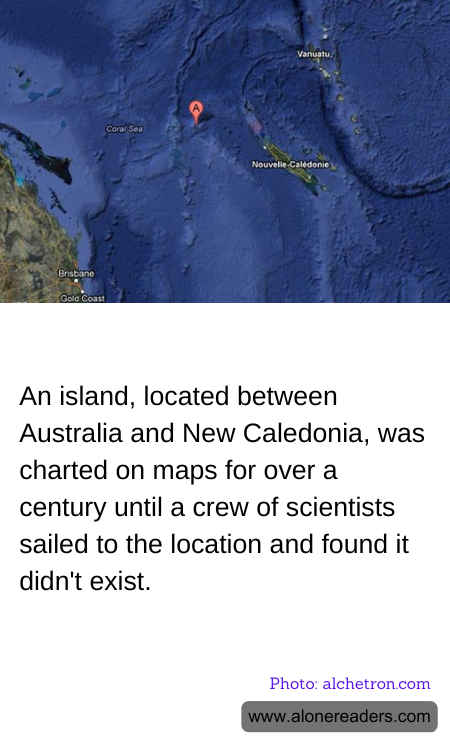
Sandy Island, a phantom island in the Coral Sea, was one such geographical enigma. Reported to be located between Australia and New Caledonia, Sandy Island had been included on maps and marine charts since as early as the 19th century. The island even appeared on Google Earth and in some scientific publications, raising curiosity and speculation among explorers and scientists alike.
The intrigue surrounding Sandy Island continued until a 2012 scientific expedition led by Australian researchers aimed to directly study the supposed landmass. When the Southern Surveyor, an Australian scientific research vessel, reached the coordinates that should have corresponded to the location of Sandy Island, the crew found nothing but open ocean. The depth soundings, which help determine the depth of the ocean floor, indicated deep water rather than the shallow waters typical of an island environment.
This discovery led to the realization that Sandy Island had never existed; it was a mistake that had been propagated through generations of cartographers. The origins of Sandy Island on maps may stem from a variety of sources including data errors, misreported observations, or false pings on hydrographic equipment. The persistence of its inclusion on maps was likely due to the sometimes slow and iterative process of map correction and the reliance on historical data without verification.
Further investigation revealed that it was not an uncommon occurrence for such phantom islands to appear in historical records and modern maps. For navigational maps, which are crucial for safe ocean navigation, the presence of a non-existent island poses significant risks, thus underscoring the importance of accurate and updated geographic data. Following its non-discovery, Sandy Island was officially removed from nautical charts and digital maps, rectifying a curiosity that had mystified the geographic community for over a century. This event highlights the dynamic and ever-evolving nature of geographical knowledge and cartographic practice.
