More About This Card
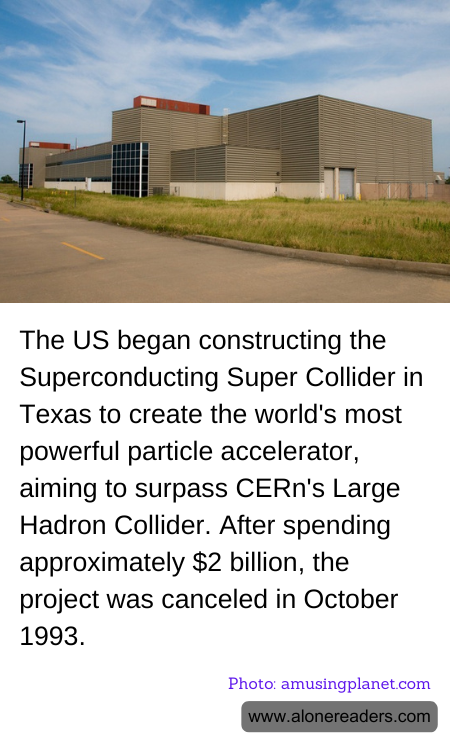
In the late 1980s, the United States embarked on an ambitious scientific project to build the world's largest and most powerful particle accelerator, the Superconducting Super Collider (SSC), in Waxahachie, Texas. The motivation behind the SSC was to maintain the country’s leadership in scientific research, specifically in the field of particle physics. The design envisioned an enormous ring complex, with a circumference of 54 miles, intended to be nearly three times larger than CERN's Large Hadron Collider (LHC) in Switzerland.
The SSC's goals were to delve deeper into the fundamental structure of matter and to possibly uncover the Higgs boson before any other laboratory could. This elusive particle was key to understanding why elementary particles have mass and to completing the Standard Model of particle physics. The completion of SSC would have drastically increased the energy with which particles could collide, creating new possibilities for discoveries about the laws of nature.
However, the project's fate was sealed by a combination of skyrocketing costs and shifting political priorities. From the outset, the development of the SSC was plagued with financial difficulties. The initial estimated cost of around $4.4 billion in the mid-1980s ballooned to an estimated $12 billion by the early 1990s due to various technical and engineering challenges. In a post-Cold War era, with decreased emphasis on scientific showpieces, fiscal conservatives and a public wary of 'big science' projects grew increasingly skeptical of the benefits derived from such a colossal investment.
In October 1993, the United States Congress officially cancelled the SSC after having invested about $2 billion in the project. By the time of its cancellation, 15 miles of tunnel was already constructed along with numerous surface buildings and facilities. The decision sent shockwaves throughout the scientific community and marked a significant shift in the global dynamic of high-energy physics research.
The remains of the SSC stood as a stark reminder of a changing attitude towards mega-science projects in the U.S., and the cancellation allowed other nations, particularly in Europe, to take the lead. The LHC at CERN, which started operations in 2008, eventually became the world’s largest and most powerful particle accelerator and, in 2012, achieved one of the main goals of the SSC by discovering the Higgs boson.
The saga of the Superconducting Super Collider is often cited as a lesson in the complexities of funding large-scale science ventures and the impacts of political and economic landscapes on advancing fundamental scientific research. It raises important questions about the future direction of scientific inquiry and the role of government in supporting such endeavours.