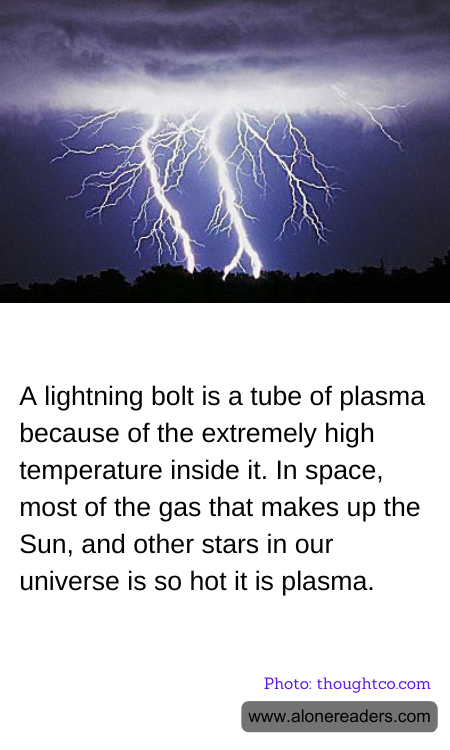
A lightning bolt is not just a spectacular natural light show; it's also a fascinating example of plasma in action on Earth. Plasma is often described as the fourth state of matter, distinguished from solids, liquids, and gases. It is a collection of charged particles that contain roughly equal numbers of positively charged ions and negatively charged electrons. The transformation of a gas into plasma requires extreme energy, typically in the form of heat, which ionizes the gas by freeing electrons from atoms and molecules.
During a lightning strike, the air around the bolt is subjected to temperatures hotter than the surface of the Sun—about 30,000 Kelvin or 53,540 degrees Fahrenheit. This intense heat causes the gases in the air (mainly nitrogen and oxygen) to ionize and form a plasma. The electrical discharge we see as lightning is essentially a flow of electrons traveling between regions of opposing electrical charge, navigating the newly created plasma channel. This conductive plasma channel can measure anywhere from a few centimeters to a few meters in diameter.
The Sun and other stars are luminous examples of plasma on a colossal scale. Stars, including our Sun, are primarily composed of hydrogen and helium gases. At their cores, nuclear fusion reactions occur at extremely high temperatures—millions of degrees—creating enough energy to ionize the gases and form an extensive state of plasma. This plasma makes up virtually all of the visible part of the Sun and other stars. Within these stellar plasma environments, charged particles are in constant motion, producing magnetic fields and resulting in various stellar phenomena like sunspots and solar flares.
Aside from lightning and stars, plasma is abundant throughout the universe, existing in places like the interstellar medium—the space between star systems within a galaxy—and even in the vicinity of black holes. Here on Earth, plasma has practical applications in technologies such as fluorescent lights, plasma TVs, and even in the manufacturing industry for tasks such as plasma cutting.
Given its presence in both everyday and extraordinary contexts, plasma plays a critical role in many natural and technological processes. From the devastating beauty of a lightning bolt to the powerful nuclear engines of stars and the vast expanses of interstellar space, plasma remains one of the most dynamic and abundant forms of matter in the cosmos.
