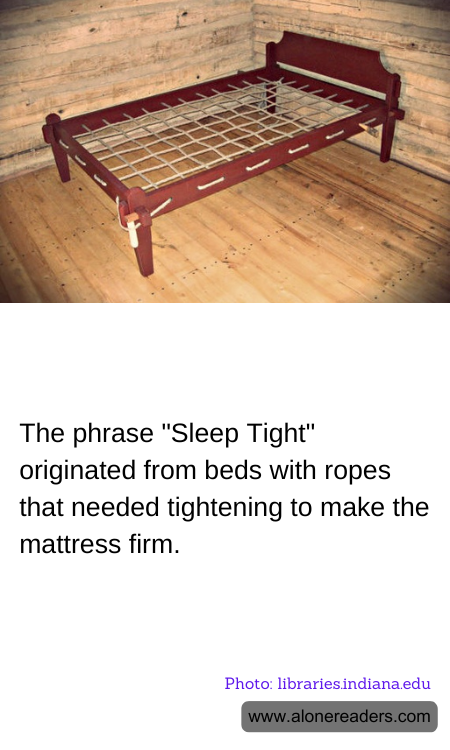
The phrase "Sleep tight" is often uttered as a parting wish for a good night's sleep, but its origins are not as well-documented as some might think. A popular theory suggests that it derives from the way beds were made in the past. Before the modern era, some beds were constructed with a wooden frame where ropes were strung tightly across in a crisscross pattern to support a mattress. If the ropes were loose, the mattress would sag, making for an uncomfortable night’s sleep. Therefore, the theory goes, “sleep tight” may have been a way to tell someone to make sure the ropes of their bed were tight enough to ensure a firm mattress.
However, linguistic experts and historians often warn against taking such explanations at face value without contemporary evidence. The phrase "sleep tight" actually appears in literature fairly late, making its first known appearance in the late 19th to early 20th century, which is somewhat inconsistent with the time period of rope beds. Additionally, the use of "tight" in the phrase is typically understood in its broader sense, meaning soundly or properly.
This might imply that "sleep tight" is simply part of a rhyming bedtime benediction, including the longer version often recited as, "Good night, sleep tight, don't let the bedbugs bite." The playful nature of rhyming verses is common in English and could be the true root of this phrase rather than any historical bedding practices. Thus, while the notion of rope-strung beds provides a charming story, the true origins of "sleep tight" might be more aligned with linguistic pattern than historical utility.
