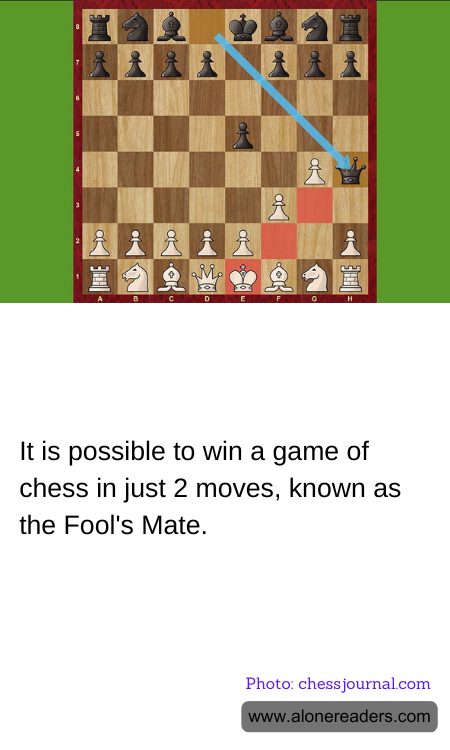
The concept of winning a chess game in just two moves, typically referred to as the "Fool's Mate," is both intriguing and rare in practical play. This checkmate pattern is the quickest possible victory in chess and relies heavily on poor play from the opponent, hence the name "Fool's Mate." It occurs in a specific and somewhat improbable sequence of moves where one player completely disregards the basic principles of opening strategy, leading to a swift defeat.
The Fool's Mate sequence unfolds in a game where the players hold the traditional colors of black and white, with white moving first. For the two-move checkmate to happen, White must make two extraordinarily weak moves that expose the king. The typical sequence would be: 1. f3 e5 2. g4?? Qh4#. In this pattern, White moves the pawn in front of the king to f3 on the first move and then disastrously moves the pawn in front of the bishop from g2 to g4. These moves critically weaken White's kingside, particularly the diagonal leading directly to White's king.
Black responds aggressively by first moving the pawn in front of the king two squares forward to e5, opening lines for both the queen and the bishop. Then, seizing the fatal error by White, Black plays the queen to h4, placing the White king in checkmate. The king, trapped by its own pieces and unable to move to any other square or be shielded by another piece, signifies the sudden end of the game.
Chess principles caution players against such premature movement of the f- and g-pawns in the opening game, as these moves not only weaken critical defensive squares but also divert development from more effective pieces like knights and bishops. The occurrence of the Fool's Mate in actual competitive play is exceedingly rare, especially as players' understanding of chess principles deepens with experience. In teaching scenarios, however, demonstrating the Fool's Mate can be an excellent way to highlight the importance of sound opening principles and the hazards of neglecting one's king safety.
Thus, while the Fool’s Mate is a dramatic illustration of what can go wrong in just two moves, it serves more as a cautionary tale rather than a strategy to aspire to. It emphasizes the foundational chess advice of controlling the center, developing pieces effectively, and safeguarding the king, all crucial for a strong game right from the opening moves.
