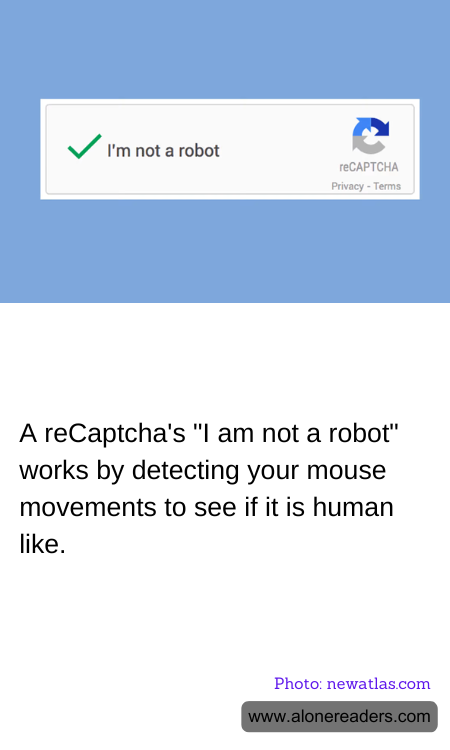
A reCAPTCHA is a type of CAPTCHA (Completely Automated Public Turing test to tell Computers and Humans Apart), which is used to determine whether the user of a website is a human or a robot. This system, developed by Google, is widely implemented across the internet to prevent abuse of services by automated programs or bots. The "I am not a robot" checkbox, a common form of reCAPTCHA, utilizes several layers of technology to detect human-like behavior without user interaction or minimal interaction.
The checkbox version, also known as reCAPTCHA v2, primarily relies on user behavior analysis, rather than just traditional tests of typing letters or solving puzzles. When a user clicks on the checkbox, the reCAPTCHA algorithm analyzes various aspects of the user's interaction with the checkbox, including, but not limited to, mouse movements. The nuances of these movements are critically insightful: humans tend to move the mouse in a way that is non-linear and has subtle speed variations, while bots typically generate perfectly straight lines or curves at constant speeds.
Moreover, reCAPTCHA incorporates advanced risk analysis techniques that run in the background. It takes into account numerous cues, such as the user’s typing patterns, how they moved to click on the checkbox, their IP addresses, and cookies, which represent previous interactions with reCAPTCHA. This comprehensive analysis helps the system deduce whether the behavior resembles that of a human or a bot.
When the system detects signs that suggest non-human behavior, it may prompt further verification through more challenging tests. These tests often include image recognition tasks where users are asked to identify objects in pictures, such as traffic lights, buses, or crosswalks. This step adds another layer of difficulty for bots, as image recognition requires spatial reasoning and contextual understanding, abilities that are typically challenging for simple automated programs.
It's significant to acknowledge that while reCAPTCHA is highly effective at deterring bots, it is continually evolving. As bots become more sophisticated, reCAPTCHA algorithms are updated to counter new strategies employed by those aiming to bypass security measures. Thus, the battle between security developers and bot developers continues, pushing the boundaries of artificial intelligence and machine learning technologies.
