More About This Card
Nalanda University, an ancient center of higher learning located in Bihar, India, was indeed one of the world's first residential universities and can be likened to a unique combination of today's prestigious institutions like Harvard, Oxford, and even NASA, given its comprehensive array of subjects and advanced studies. Established in the 5th century CE, Nalanda stood as a beacon of excellence in the ancient world and remained active until approximately the 12th century.
The university had a rigorous intellectual culture that attracted scholars from all corners of the ancient world, including Tibet, China, Korea, Japan, Indonesia, Persia, and Turkey. This international melting pot of minds comparable to today’s global universities like Harvard and Oxford, helped disseminate knowledge across continents.
Interestingly, Nalanda’s curriculum encompassed a vast breadth of knowledge systems including theology, grammar, logic, astronomy, medicine, and philosophy suggesting a likeness to modern comprehensive universities. The presence of advanced courses in astronomy and medicine specifically links it metaphorically to institutions like NASA, where the edge of scientific understanding is continuously pushed forward.
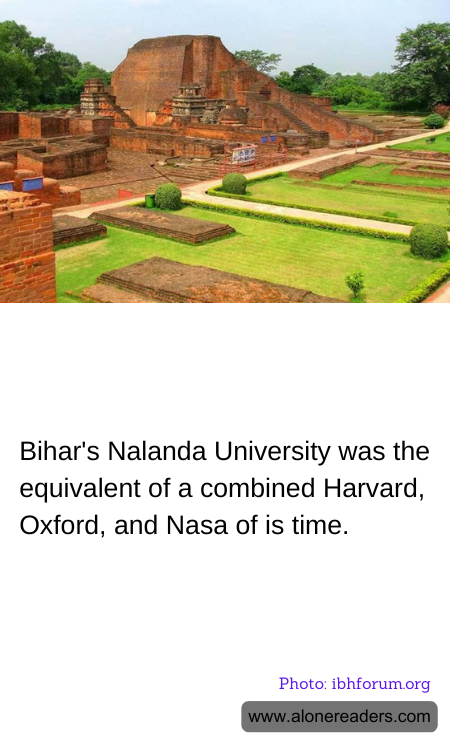
The architecture of Nalanda was also quite advanced for its time, consisting of red brick buildings that housed classrooms, stupas, meditation halls, and a grand library named Dharmaganja, which contained thousands of manuscripts. The extent of intellectual and infrastructural development arguably made Nalanda the most revered university of its time, highlighting a blend of scholastic enterprise and structural grandeur.
The legacy of Nalanda is a testament to the enduring value of education in human culture, transcending the physical and temporal bounds of the university itself. Although it was eventually destroyed in the 12th century by invaders, Nalanda continues to inspire modern academic institutions and educational philosophies around the world. Its revival in the form of the modern Nalanda University, aimed at capturing the spirit of the original institution, underscores its everlasting significance in the global academic landscape. This revival seeks not only to restore the glory of its ancient predecessor but also to advance learning in the spirit of its distinguished and holistic educational approach.