More About This Card
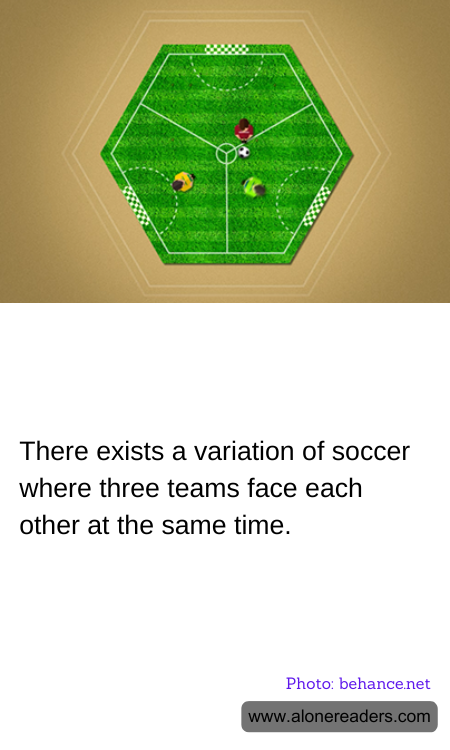
In a unique twist on traditional soccer, a version known as three-sided football offers an innovative and strategic interpretation of the game, where three teams compete simultaneously. This adaptation radically alters both the dynamics and tactics of conventional soccer, transforming the way players and teams navigate the pitch.
Three-sided football is played on a hexagonal field, with goals positioned at every other vertex, presenting a more complex and challenging environment than the typical rectangular field. Each match involves three teams, and the objective is not just to score the highest number of goals but to concede the fewest, adding a layer of strategic defensive play that is uncommon in traditional soccer. This rule encourages teams to think not only about attacking but also about forming temporary alliances, strategizing against the currently leading team.
The origins of three-sided football are intellectual as well as athletic. It was conceived by the Danish artist Asger Jorn in the 1960s to explain his notion of triadic philosophy, which posits that a three-point system of logic, rather than binary, leads to more nuanced and dynamic relationships and understandings. The game was first played in earnest in the 1990s, expanding from an abstract idea to a physical sport played by enthusiasts around the world.
Strategies in three-sided football can be complex. Teams must constantly decide whether to attack, defend, or temporarily ally with another team to prevent the third from scoring. This constant need for strategic flexibility and adaptation can make three-sided football as much a mental challenge as a physical one.
Despite its niche status, three-sided football has grown in popularity in various parts of the world, fostering a community of players who are drawn to its unorthodox approach and the added depth of play it offers. The game challenges conventional norms and strategies of team sports, making it a fascinating study in both human psychology and athleticism.