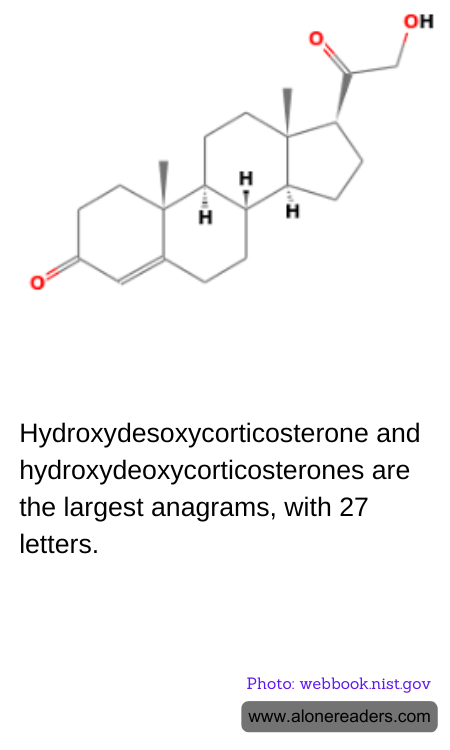
The English language is filled with curiosities, and among them are anagrams, words or phrases formed by rearranging the letters of a different word or phrase, typically using all the original letters exactly once. Some anagrams are particularly notable for their length, and hydroxydesoxycorticosterone alongside hydroxydeoxycorticosterones hold the record as the largest anagrams, each consisting of 27 letters.
Hydroxydesoxycorticosterone is a lesser-known chemical compound related to steroid hormones, while hydroxydeoxycorticosterones, as suggested by its name, relates to steroid structures as well. The chemical complexity of these compounds reflects in their names, comprising a mix of prefixes like "hydroxy" and "deoxy," which indicate the presence of specific functional groups (hydroxyl and the absence of oxygen, respectively), and "corticosterone," a steroid hormone that plays a vital role in various bodily functions including stress response.
These two anagrams not only share a relationship through their chemical nature but also serve as a fascinating example of linguistic playfulness in the scientific lexicon. The fact that they are anagrams is likely coincidental, a quirk arising from the systematic naming conventions in chemistry where similar compounds often have similar names. This characteristic demonstrates the intersection of language and science, where terms are created not just for functional communication within scientific communities but also inadvertently lead to interesting word plays.
Anagrams like these are not only fun but also serve as educational tools, helping students and professionals alike remember complex terminology through mnemonic devices. Moreover, this particular pair of anagrams highlights the creativity involved in scientific nomenclature, making the study of both language and science a bit more engaging. While they may not appear in everyday conversation, hydroxydesoxycorticosterone and hydroxydeoxycorticosterones encapsulate the beauty of the English language's capacity for word formation and the intricate nature of scientific terminology.
