More About This Card
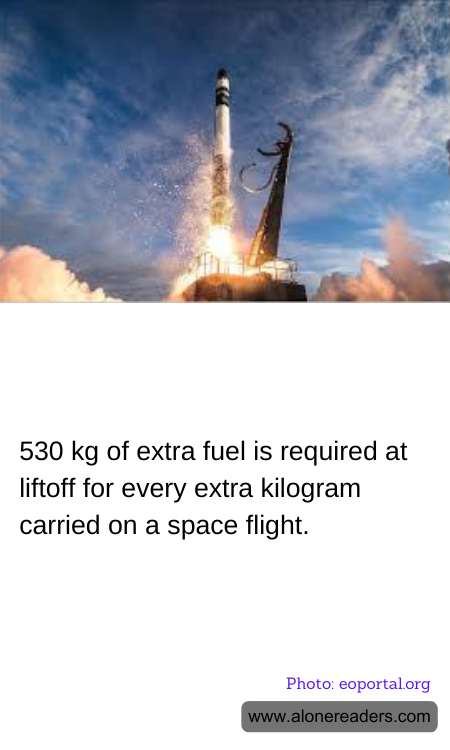
The logistics of space travel are far more complex than those of any Earth-bound transportation due to the extreme conditions and precise engineering required. One striking example is the fuel requirement for carrying extra weight: it is estimated that an additional 530 kilograms of fuel are required for every extra kilogram of payload carried into space. This exponential increase in fuel needs arises primarily due to the nature of the Earth's gravitational pull and the mechanics of orbital physics.
In space travel, every segment of the journey must be meticulously planned, with payload weight playing a critical role. Rockets must overcome Earth's gravitational force to reach orbit, a feat that demands a significant amount of energy. The bulk of a rocket's mass at launch is actually its fuel; the Saturn V rocket, for example, used in the Apollo missions, was approximately 85% fuel by weight at liftoff. As payload weight increases, the fuel required grows dramatically, not linearly but almost exponentially, because additional fuel adds more weight, which in turn requires even more fuel.
This principle is guided by what is known as the rocket equation, which describes the relationship between the mass of the rocket, the velocity it can achieve and the mass of the fuel. Importantly, every extra bit of mass that needs to be propelled into space (including the fuel itself) requires proportionately even more fuel — leading to rapid escalations in the amount required as payload increases.
Such stringent weight-to-fuel ratios have significant implications for space mission planning, including costs, vehicle design, and sustainability practices. Given the high cost of launching material into orbit — often tens of thousands of dollars per kilogram — every extra kilogram is scrutinized. This is why considerable effort is put into developing lighter materials and more efficient technology for space travel.
Innovations such as reusable launch vehicles, exemplified by SpaceX's Falcon 9 and Falcon Heavy rockets, are also aimed at reducing these costs. By recovering and reusing parts of the rocket, these technologies can diminish the overall mass that needs to be lifted per mission in the long term, ideally reducing the proportional amount of fuel required per kilogram of payload.
The challenge of extra fuel needs for additional payload weight is also a constant consideration in plans for longer missions, such as those intended for Mars or other deep space destinations. For these voyages, the balance between payload and fuel becomes even more critical, as the possibilities for refueling or resupply are limited if existent at all, and efficiency in every aspect of the spacecraft's design is paramount.