More About This Card
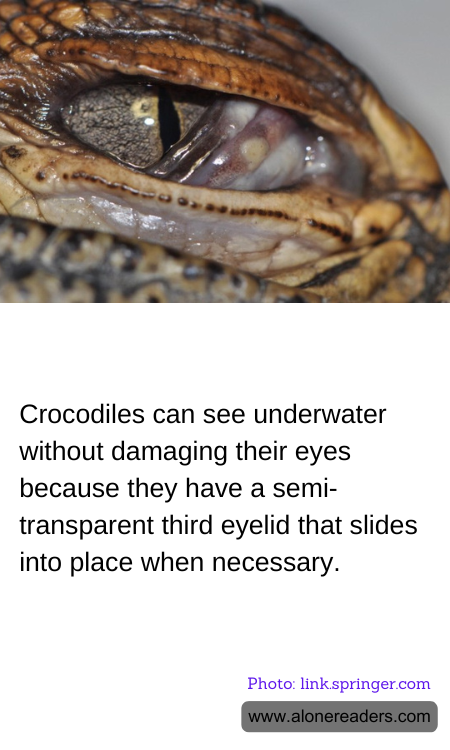
Crocodiles, those ancient predators that have roamed the Earth for millions of years, have adapted various unique biological features to thrive in their aquatic environments. One of their most fascinating adaptations is the ability to see underwater with remarkable clarity. This ability is primarily due to a special anatomical feature known as the nictitating membrane, often referred to as the third eyelid. This third eyelid is semi-transparent and acts much like a pair of natural goggles when it slides across the eye.
The nictitating membrane serves multiple purposes. Firstly, it protects the crocodile's eyes from debris and other potential irritants in the water. This is crucial, as crocodiles often deal with murky and sediment-rich water where particles could easily scratch or damage their eyes. The membrane shields the sensitive corneal surface, thereby preventing injuries that could impair the crocodile’s ability to hunt or navigate its environment.
Secondly, this third eyelid helps to improve the crocodile's vision under water by smoothing the water's refractive properties, which can distort visual perception. The membrane moistens the eye with a lubricating film and provides a consistent refractive surface, enhancing the crocodile’s visual acuity underwater. This is critical for spotting prey and avoiding obstacles or predators.
Moreover, the design and functionality of the nictitating membrane enable crocodiles to see with equal effectiveness both in and out of water. When above water, the membrane retracts, and the crocodile relies on its outer eyelids, which offer sharper vision in air. This dual visual capability allows crocodiles to transition seamlessly between aquatic and terrestrial environments, making them formidable predators in both realms.
Scientific studies indicate that the nictitating membrane may also help to improve the accuracy of a crocodile’s underwater hunting. By reducing flare and improving contrast, this third eyelid allows crocodiles to accurately judge distances, which is crucial when striking at fast-moving fish or other aquatic creatures.
In conclusion, the crocodile’s third eyelid is not just a physical shield, but also a finely-tuned optical device that has evolved perfectly to suit its wearer’s predatory lifestyle. Such adaptations highlight the remarkable ways in which life on Earth evolves mechanisms for survival and efficiency across diverse and challenging environments.