More About This Card
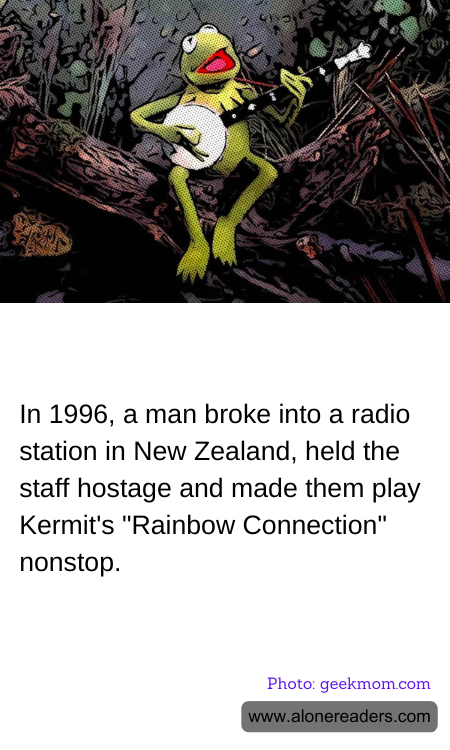
In an unusual blend of menace and whimsy, an incident that unfolded in 1996 at a New Zealand radio station has since become the stuff of local legend and a curious footnote in the annals of broadcasting history. The peculiar event took place when a man, reportedly distressed and seeking a platform to be heard, broke into a radio station. His demands were far from typical: rather than seeking ransom or espousing political beliefs, the man compelled the station's staff to continuously play a seemingly innocuous song—Kermit the Frog's "Rainbow Connection."
"Rainbow Connection," originally performed by Jim Henson as Kermit in 1979 for "The Muppet Movie," is a song that resonates with themes of hope and the pursuit of dreams. It's known for its gentle melody and heartfelt lyrics, making it an unlikely choice for a hostage situation soundtrack. The intruder's insistence on this particular song, played on loop, turned a tense situation into an almost surreal tableau, leaving the staff and later, listeners, in a bizarre state of mind where fear met the oddly comforting strains of Kermit’s voice.
During the standoff, the unharmed but shaken radio station employees were forced to ensure the song played over and over, while police negotiated with the man. Although details about the intruder’s motives have remained somewhat nebulous, it appears that the song held significant personal meaning to him, serving perhaps as a sonic refuge in a moment of personal crisis.
The incident concluded without physical harm when the police managed to apprehend the man after several hours, thus ending the odd serenade. This story, while alarming in its outline of a hostage scenario, also highlights the peculiar ways in which people may seek to express deep-set emotions or unresolved turmoil. Moreover, it underscores the powerful role that music can play in human life—as a source of comfort, a trigger for memories, or even, as in this strange case, a medium for making a statement in a moment of desperation.
Today, the "Rainbow Connection" siege remains a memorable event not only for its immediate participants but also for a wider public who continue to share and recount the tale, often with a mix of disbelief and a recognition of the profoundly moving impacts of music. It serves as a reminder of the unpredictable ways in which the human mind can react to stress and the universal language of music that speaks in diverse and sometimes unexpected forms.