More About This Card
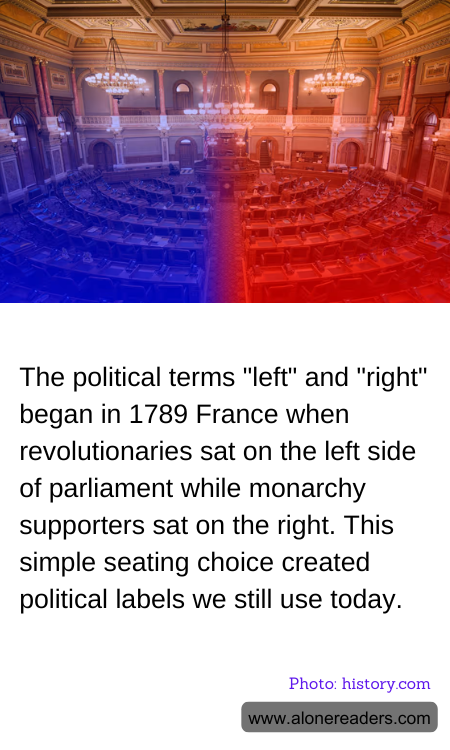
The origins of the political labels "left" and "right" trace back to a significant moment in history during the French Revolution in 1789. In the Estates-General, an assembly that represented various classes of French citizenry, a defining spatial arrangement occurred. Those who supported the revolution, favoring sweeping social and political changes, chose to sit on the left side of the assembly. Opposite them, on the right side, sat the conservatives who were supportive of the Ancien Régime and the monarchy, advocating for maintaining the status quo.
This seating arrangement transcended its original context to become a globally recognized system of political classification. Over time, the terms "left" and "right" have come to reflect broad ideologies beyond mere support for or opposition to monarchy. The "left" generally champions equality, social justice, and collective community and governmental responsibility towards citizens. These ideals often translate into support for progressive policies, social welfare programs, and a regulatory approach to economics.
Conversely, the "right" often prioritizes tradition, personal freedom, and a reduced role for government in daily life, advocating for free-market policies, individual self-reliance, and conservative values regarding social and cultural issues. These principles can manifest in favor of strong national defense, limited government intervention in the economy, and preservation of traditional social norms.
What is particularly fascinating about the evolution of these terms is how they have adapted and shifted in meaning across different countries and historical periods. In some contexts, "left" and "right" can align closely with social issues, while in others, they might predominantly reflect economic ideologies. In today’s global political landscape, these terms still serve as shorthand descriptors that help categorize political beliefs, parties, and ideologies, although the nuanced distinctions between and within these categories can be quite complex.
Moreover, the application and implications of being 'left' or 'right' wing can vary dramatically within different political cultures and systems. Hence, while these terms have historical roots in a seating arrangement from over two centuries ago, their contemporary meanings are shaped by dynamic and evolving political, social, and economic contexts worldwide. This enduring dichotomy continues to influence political discourse and public policy, demonstrating the lasting impact of seemingly simple choices made during pivotal moments in history.