More About This Card
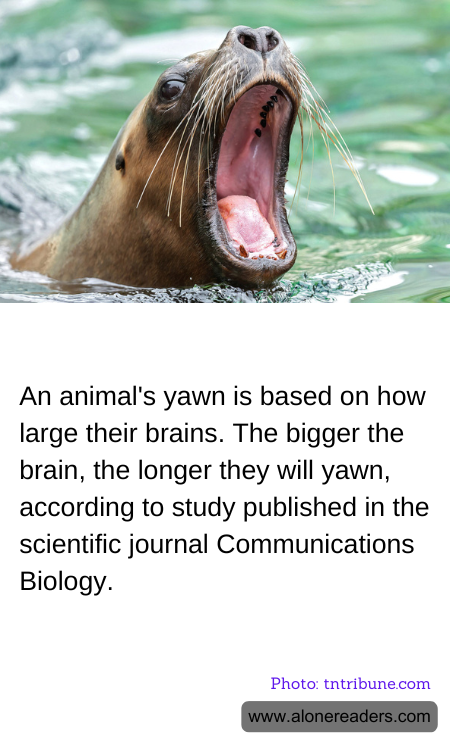
Yawning, a behavior observed across various animal species, has recently been linked to brain size according to a fascinating study published in the journal Communications Biology. Researchers have found a direct correlation between the size of an animal's brain and the duration of its yawn. This discovery suggests that the act of yawning may have deeper biological and neurological implications than previously understood.
The study meticulously analyzed the yawning behaviors of different animals and noted that species with larger and more complex brains tend to have longer yawning durations. For instance, humans, with their relatively large brains, have yawns that last significantly longer than those of smaller-brained animals like mice or rabbits. This pattern suggests that the yawn could be serving a specific function related to brain activity and health.
One theory proposed by scientists is that yawning could be helping to regulate the brain's temperature and facilitate brain cooling, a critical function for maintaining neurological health. The longer yawn in animals with large brains could therefore be an adaptation to manage the greater heat production associated with more extensive neural processing. Additionally, yawning might also increase blood flow to the brain, helping to remove metabolic waste products and distribute neurochemicals more efficiently.
Interestingly, the study also delved into the social and evolutionary aspects of yawning, considering that many species known for their social behavior, such as primates and canines, exhibit contagious yawning. This phenomenon could be linked to empathy and group cohesion, suggesting that yawning serves multiple functions, including social communication and synchronization.
This research not only provides an intriguing insight into a common but often overlooked behavior but also underscores the complexity of seemingly simple biological actions. By further exploring how yawning relates to brain size and function, scientists can enhance our understanding of the neural mechanisms underlying a variety of cognitive and social behaviors in animals, including humans. This study lays the groundwork for new inquiries into how everyday actions reflect the physiological characteristics of different species and continue to shape their evolutionary trajectories.