More About This Card
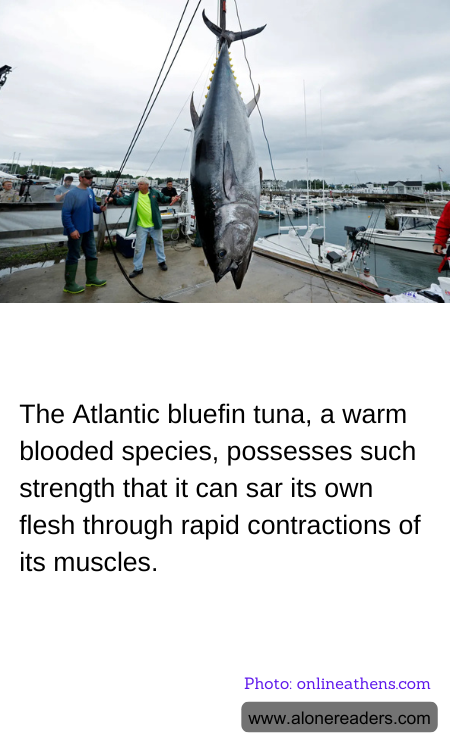
The Atlantic bluefin tuna, one of the most awe-inspiring creatures in the ocean, is known not only for its immense size and speed but also for a unique physiological trait: it is warm-blooded, a rare characteristic among fish. This ability allows the bluefin tuna to regulate its body temperature, maintaining it higher than the surrounding water. This adaptation provides significant evolutionary advantages, such as enhanced muscle efficiency, faster swimming speeds, and the ability to inhabit colder waters, expanding their feeding and breeding grounds.
The muscle structure of the Atlantic bluefin tuna is extraordinarily powerful. The power of their muscle contractions can be so intense that it actually poses a risk to the fish itself. During high-speed chases or when struggling against a fisherman’s line, the bluefin tuna’s muscles can contract with such force and speed that it can lead to self-inflicted injuries, including muscle and flesh damage. The muscle contractions generate a tremendous amount of energy and heat, occasionally causing the fish's own tissues to tear.
Despite this risk, these robust contractions are crucial for their survival, facilitating their high-speed bursts which are essential during hunting or when evading predators. Scientists and researchers are particularly interested in the bluefin tuna’s ability to sustain these high energy outputs without causing more frequent harm to themselves. The study of these creatures not only helps in understanding their physiology and ecological role but also aids in better management practices for their conservation, given their status as a highly prized species in markets, particularly for sushi and sashimi.
The life of the Atlantic bluefin tuna is a balance of power and vulnerability, showcasing the complexities of their existence in the open seas. Understanding these dynamics is key to ensuring their survival and managing the ecological impact of human consumption patterns on this magnificent species. As such, ongoing research and sustainable fishing practices are critical in preserving the population levels of the Atlantic bluefin tuna, allowing them to thrive in their natural habitat while maintaining the biological diversity and health of ocean ecosystems.