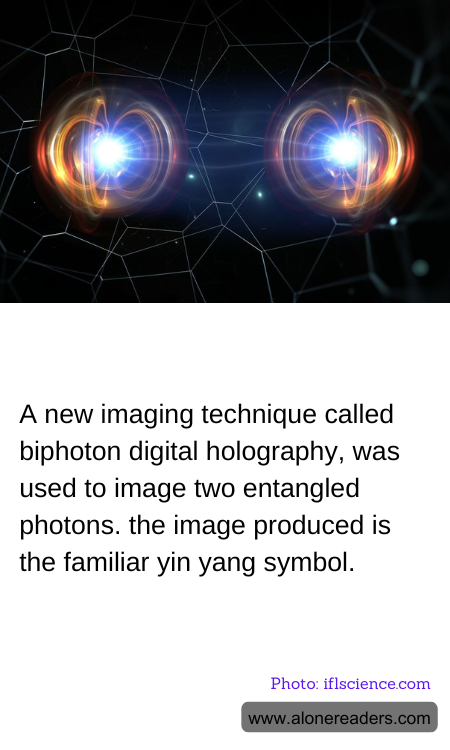
In a groundbreaking development in the field of quantum imaging, researchers have successfully harnessed a technique known as biphoton digital holography to capture an image using two entangled photons. Remarkably, the resultant image closely resembles the ancient Chinese yin-yang symbol, a representation deeply rooted in Taoist philosophy symbolizing dualism and balance. This serendipitous imagery emerged during experiments designed to explore the limitations and capabilities of quantum entanglement in improving imaging techniques.
Biphoton digital holography involves the use of a pair of photons that are quantumly entangled, meaning the state of one photon is directly correlated with the state of its partner, regardless of the distance between them. This entanglement property was exploited to create an interference pattern which was then captured digitally to form a coherent image. Traditional imaging methods rely on classical light properties and face challenges like lower resolution and higher susceptibility to noise. In contrast, quantum imaging promises enhanced resolution and decreased noise, opening new avenues for observing phenomena at unprecedented scales.
The appearance of the yin-yang symbol in the experiment was an unintended yet fascinating aspect. This outcome illustrates the often unpredicted pathways scientific investigations can take, yielding results that resonate culturally and philosophically as well as technically. In this instance, the yin-yang pattern, comprising a dark and light swirl each containing a dot of the opposite color, captures a fundamental truth about the quantum world: opposites not only coexist but are interconnected in complex and inseparable ways.
This imaging breakthrough not only paves the way for advances in how we visualize microscopic and quantum realms but also provides a striking metaphor for the nature of these realms—complementary yet opposing forces that together create a dynamic system. As researchers continue to delve deeper into the capabilities of quantum imaging, concepts like super-resolution and the ability to capture images in extreme conditions without using high-intensity illumination are becoming realistic possibilities. The implications of this research extend beyond pure science, potentially revolutionizing fields such as medical imaging, security, and information processing, all the while deepening our understanding of the fundamental principles of the universe.
