More About This Card
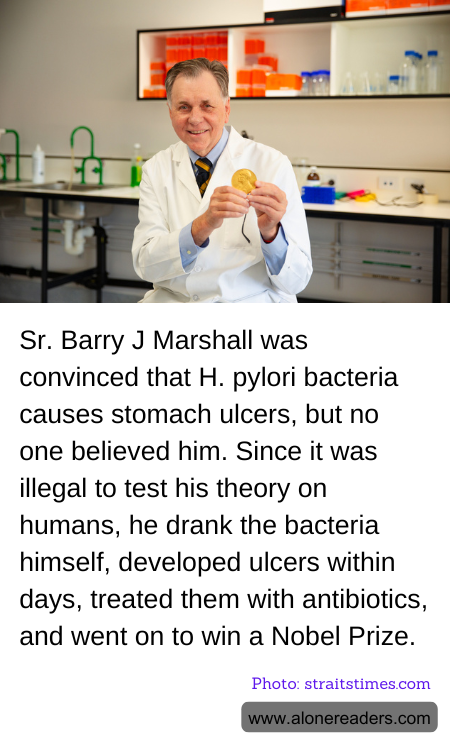
In a groundbreaking act of self-experimentation, Dr. Barry J. Marshall provided one of the most dramatic pieces of evidence in modern medical science, which would eventually earn him the Nobel Prize in Physiology or Medicine in 2005. For years, the prevailing belief among gastroenterologists was that peptic ulcers were caused by stress, spicy foods, and too much acid. However, Marshall, an Australian physician, was convinced that the bacterium Helicobacter pylori (H. pylori) was the actual culprit behind these painful digestive tract lesions.
Faced with skepticism from the medical community and regulatory barriers that prevented him from conducting traditional human trials, Marshall took an unusual and risky step. In 1984, he ingested a Petri dish containing cultured H. pylori, intending to prove his hypothesis. True to his theory, within just a few days, he developed gastritis, the precursor to ulcers. His symptoms escalated rapidly, and he began experiencing nausea and halitosis, which are typical of an infection with H. pylori.
Afterwards, Marshall underwent an endoscopy which confirmed the presence of H. pylori and signs of gastritis. He then self-administered antibiotics to treat the infection, and shortly thereafter, his symptoms subsided. This personal experiment provided compelling, direct evidence that H. pylori infection could indeed cause stomach inflammation and ulcers.
Marshall's daring self-experiment fundamentally changed the understanding of gastrointestinal diseases. It led to a paradigm shift in the treatment of peptic ulcers, moving away from surgeries and long-term acid suppression to the use of antibiotics and other medications aimed at eradicating H. pylori. This shift not only improved treatment outcomes but also dramatically reduced the prevalence of stomach ulcers and minimized the risk of more severe complications like stomach cancer.
Marshall's work is a quintessential example of how challenging existing paradigms, combined with innovative (though risky) scientific methods, can lead to revolutionary advancements in medical science. His willingness to use himself as a test subject highlighted his dedication and confidence in his research, characteristics that are often essential for breakthrough discoveries in science.