More About This Card
The intriguing story of the Roman glassmaker who allegedly invented an unbreakable glass in the 1st century reflects a poignant tale of innovation clashing with power. As per historical anecdotes, this craftsman presented his creation to Emperor Tiberius, who was initially impressed by a glass vessel that could bend and distort without breaking. However, the emperor soon realized the economic implications of such a material. At the time, precious metals like gold and silver were standards in wealth and status. The introduction of an unbreakable glass threatened to devalue these materials, potentially destabilizing the economy based on their worth.
Feeling threatened by the revolutionary potential of the unbreakable glass, Tiberius decided to eliminate the risk. In a drastic move, he ordered the execution of the glassmaker, thereby burying the technology with him. This decision by Tiberius was aimed not only at safeguarding the economic structure of the empire but also at maintaining the scarcity and value of the materials then in use for making vessels and other artifacts. By doing so, he effectively stifled innovation due to personal and state-level economic fears.
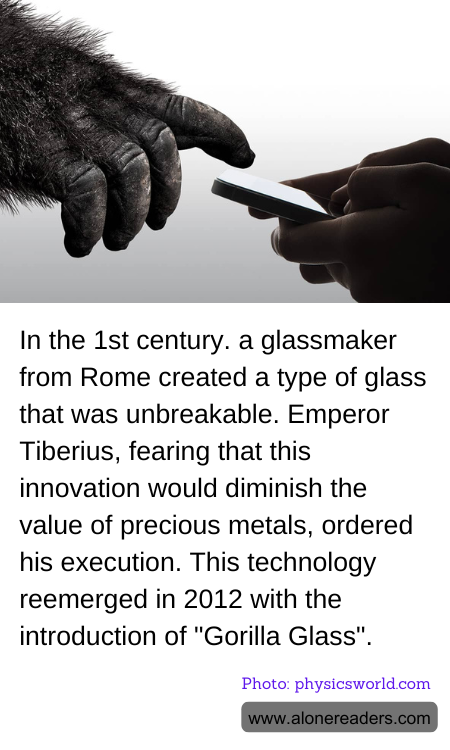
Centuries later, the concept of durable and near-unbreakable glass was revived in a modern context with the advent of technologies like Gorilla Glass, which was introduced in 2012. Developed by Corning Incorporated, Gorilla Glass is engineered for a high degree of damage resistance and is used primarily to protect the screens of mobile devices, laptops, and televisions. Unlike the lost invention of the Roman glassmaker, Gorilla Glass has been widely adopted and has significantly influenced the design and durability of consumer electronics.
The resilience of Gorilla Glass reflects the original intention behind the Roman glassmaker’s innovation— to create a durable and more practical material. While Tiberius's fear of economic disruption was based on the context of his time, the contemporary embrace of technologies like Gorilla Glass illustrates a society that values innovation with a view towards improving utility, durability, and ultimately, the consumer experience. The stark difference in the fates of similar innovations, separated by thousands of years, highlights an evolution in how human societies perceive and integrate technological advancements.